


Spring Break TSA Nightmare: Top Ten Cartoons of the Week

 DarylCagle.com
Keith Knight amuses me. We recently chatted in the bar at the National Cartoonists Society (NCS) convention that Keith was crashing. As something of an NCS historian, I thought I would respond to Keith’s suggestions in cartoon form below.
Hold the convention in a smaller town.
We’ve had some odd convention locations in the past. The convention in Asheville, NC wasn’t very well attended but was one of my favorites. I think my favorite one of all time was the one in Cancun, Mexico, where I never would have otherwise gone and the attendance was the lowest I can remember. The problem with odd locales for the convention is that attendance drops. In fact, I could make an argument for always having the convention in California or near New York City every year.
Aggressively court web and indie cartoonists.
The NCS should be doing that. They haven’t really been “courting” anybody.
Have certain convention events open to the public.
That’s a suggestion that has spawned some heated debate. In the past, when the NCS has had public events, we either had a bad experience or a poor turnout. An exception was a fairly successful book signing/public event at the convention in San Antonio ten years ago.
The one us old-timers remember is the debacle in San Francisco about 18 years ago, where the cartoonists and the public were invited to a reception/signing at a book store and the public mobbed Jim Davis (Garfield) and Charles Schulz (Peanuts), rudely driving them away and ignoring the other cartoonists. It was pretty unpleasant.
I remember in the bar at the St. Francis Hotel that night, the cartoonists were joking about how they could all draw Garfield and should all just say they were Jim Davis. The hotel staff gave the cartoonists white plates and sharpie markers to draw on the plates ““ in exchange for a drawing on a plate, the cartoonist could have a free drink. The hotel ended up with a huge stack of worthless drawings of Garfield on plates, signed by faux Jim Davises. I heard the NCS, Ohio State or somebody got a call from the hotel years later, asking what to do with “all your plates.” I believe they ended up on the trash heap of history.
Keith’s suggestion about “cartoonist vs. cartoonist action + beer” misses the point. Â The cartoonist vs. cartoonist action IS the beer.

I’ll be moderating a panel of political cartoonists at the San Diego Comic Con again this year, on Sunday, JULY 26th, from 11:30am-12:30pm in ROOM 5AB.  Pat Oliphant will be there as a Comic Con special guest, and I’ll invite some local editorial cartoonists again, but I was wondering if there are any cartoonists, whose work is featured on our Cagle.com site, from outside of California, who will be in the area for Comic Con, that I wouldn’t have thought to invite and who would like to be on the panel – please let me know.
The Comic Con has gotten too big for San Diego, I understand the convention is already sold out. Â I think it is time they moved to Las Vegas. Â Cartoonists should still be able to get in, though, by registering as professionals. Â I can be found at the Comic Con hanging around with my buddies at the National Cartoonists Society booth most of the time.
I’m pretty reclusive and enigmatic, but you can spot me at a rare public appearance in Tokyo at the Hara Museum of Contemporary Art on Saturday, June 13th from 3:00 to 4:30pm. I’ll be giving a talk on The Evolving Role of Political Cartoons with Japanese translation.
If you’re passing through Tokyo, come on by. A reservation is required. Please make your reservation by phone at TEL: 03-3445-0669 or E-mail: [email protected] with your name, contact phone number and number of people attending. I’m told there is an interesting exhibition there: “The Exploration of the Micropop Imagination in Contemporary Japanese Art.”
I Twittered about this provocative abortion cartoon and got such a discussion on my Facebook page that I decided to post it here for comment. Â Frankly, it seems to me that if pro-lifers really believed their own hot-headed rhetoric, that “abortion is murder,” we’d see many more desperate, violent responses, like the killing of this doctor.
Gary McCoy is our resident, knuckle-dragging conservative pro-lifer. Â I’ll be interested to see the comments on this cartoon. Â We got a crazy number of responses some years ago to a Michael Ramirez cartoon depicting a fetus in an electric chair. Â I can always count on abortion, the Confederate Battle Flag, gun control and cartoons about Jews and Islam to bring on the most emotional, angry response.

 I haven’t gotten many comments here, but I’ve been getting some nice e-mails about my Muppets post and I thought I’d put up a little more.
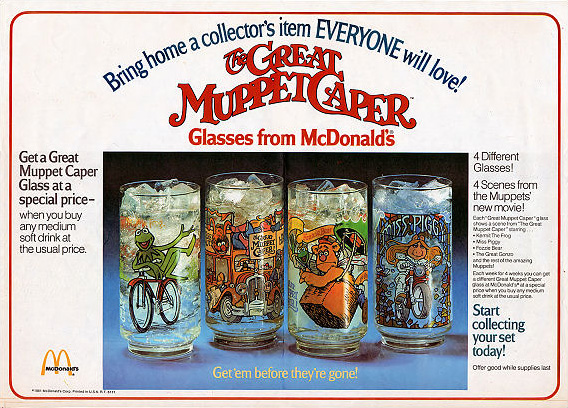
Most of my old Muppet work was pretty obscure; people remember the McDonalds glasses and, if they wore my Keds shoes or Timex watches, they remember those. Â Two more that people seem to remember are:Â Post Croonchy Stars, the Swedish Chef cereal. Â I did the puzzles and games that updated each month on the backs of the cereal boxes; kids read these as they ate their morning sugar. Â I still have some boxes of Post Croonchy Stars in the garage, and I think they are still as fresh and edible as the day they hit supermarkets.
When little Muppet fans’ baby teeth rotted from all that sugar, we were ready with my Muppet Oral B toothbrushes; these seemed to stay in the stores for about 20 years.
Oh, those were the days.


I was amused and flattered to see a site, toplessrobot.com, that thinks my old McDonald’s Great Muppet Caper Glasses were the second best fast food premium glasses ever. Â Its amazing that they knew I drew them. Looking at the commercial makes me feel young again – I was fresh out of college when I was churning out Muppet art in the early 1980’s. Â Jim Henson really made a career for me; the Muppets were my grad school. Â (They pick Star Wars glasses as #1 … oh well.)
[youtube]http://www.youtube.com/watch?v=HrrS8zH6-bE&feature=player_embedded[/youtube]
Here’s a game box I did in 1981 for Milton Bradley, also tied into The Great Muppet Caper movie.

I searched myself on Muppet Wikia. Â It is a trip down memory lane (not unlike a trip into the bowels of my garage, which is filled with this stuff).
The Huffington Post, which famously pays nothing to its writers, has a ridiculous piece by Jason Notte about “Ten Features That Are Dying with your Newspaper;” included on the list are editorial cartoons and one comic, The Family Circus. Notte writes:
9. Editorial Cartoons: You know those witty, insightful, stinging illustrated summaries of current events that make their way onto the op-ed page? In 10 years, you may be in the minority. If newspaper’s death knell is ringing, editorial cartoonists are pulling the rope. The head of the American Association of Editorial Cartoonists said four years ago that the number of full-time editorial cartoonists in the U.S. had dropped from 200 to 80. For his part, cartoonist and AAEC president Ted Rall has been putting together nearly as many layoff updates as illustrations these days. Remember when censorship was an editorial cartoonist’sbiggest worry? Apparently, those were the good times.
This is typical of the Huffington Post’s attitude about the “death of newspapers” as they crow about how they are the next new big thing in journalism ““ although they operate on round after round of venture financing, without a sustainable business model, stocked with content from volunteers.
Editorial cartoons have never been more popular. With the Web in addition to newspapers, political cartoonists now have the largest audience they have ever had. Political cartoons are featured on state mandated testing in high schools in every state and teachers teach to the tests, creating new fans of our art form every year. The work being done by editorial cartoonists now is better than ever before.

We syndicate a package of editorial cartoons. We’re seeing a small decline in newspaper sales that is being offset by an increase in other kinds of sales that we get though being easy to find on the Web. Our syndication business is flat, which is disappointing, but it is fine. The audience for cartoons continues to grow.
There are about 1,500 daily newspapers in the USA, of that number, probably about 80 employ full time cartoonists. Ten years ago there were more than 100, ten years before that maybe 140, back in 1960 there were probably about 200 newspapers that employed full time editorial cartoonists. That is a big percentage decline in the number of cartooning jobs in the past fifty years, but it is not a big drop in the number as a percentage of the total number of newspapers ““ the vast majority of newspapers have never employed a full time cartoonist.
I scream and wail about the loss of full time cartoonist jobs and the decline in newspapers, but the truth is it has always been unusual for a newspaper to hire a cartoonist. Newspapers have been running inexpensive syndicated cartoons for many decades and those syndicated cartoonists are the stars whose work gets seen, while local cartoonists are obscure. Syndication pays poorly because of decades of competition between the syndicates with an oversupply of good cartoons and has little or nothing to do with the decline of newspapers.
We are not seeing a decline in the number of active editorial cartoonists with the losses of full time jobs; just the opposite is happening, there are more now, plugging away as freelancers, scraping a living together from paying and non-paying clients.
The current situation for cartoonists is no different than the situation Notte finds himself in – with a big audience for his work as he writes for free for the Huffington Post, while also writing for a variety of odd clients. There will always be plenty of editorial cartoonists and plenty of writers, like Notte, plying their freelance trade no matter what happens to newspapers.

From my e-mail box … somehow I don’t think Mr. Fish’s response to this reader will be satisfying to him.

Sent: Sunday, May 24, 2009 7:49 PM
To: cagle.com
Subject: Mr. Fish Memorial Day “Cartoon”
Please tell Mr. Booth that although it is fair to humiliate politicians who unthinkingly send young men off to war, it his improper and unacceptably demeaning to belittle those who are brought up in the tradition of answering the call to arms when it comes. The cartoon is also unbelievably cruel to those who have lost family members in defense of our country.
Unless Mr. Booth can prove he served and put his tail on the line for this country, I suggest he keep his figurative mouth shut and ink bottled rather than make fun of a tradition that keeps us free and safe Without all Kevins, you would have a very small volunteer military indeed. And whether he agrees or not, we would be far less safe and fat and happy here if that were the case.
As a Former New Yorker, now living in Oklahoma, I further submit that since this tradition is strongest in the American South, Midwest and West, the cartoon is also brazenly elitist and sectionalist. I teach returning GI’s from Iraq and Afghanistan and Booth should be first in line to kiss the ground upon which these wonderful men and women walk.
I am so sorry you gave this piece of trash the light of day.
Bob Avakian
Tulsa, Oklahoma
On May 25, 2009, at 1:04 PM, Daryl Cagle wrote:
Hola, Dwayne,
Write a nice response and I’ll post it in the blog and newsletter.
Best,
Daryl
From: Mr. Fish
Subject: Re: Mr. Fish Memorial Day “Cartoon”
Date: Mon, 25 May 2009 14:28:21 -0700
Hey Bob,
I must respectfully disagree with your assertion that we must support and honor all men and women who choose to sacrifice their bodies to the perpetuation of massive amounts of violence in any war, particularly one predicated on hubristic goals with reprehensible consequences. Additionally, to address the broader implication of your note, to suggest that the tradition of any one nation engaged in war with another (or, in this particular circumstance, the tradition of one nation invading and then occupying another) be respected merely because it is a tradition is lazy at least and fascistic at worst. Remember, slavery was also a tradition. Should that atrocity be respected as well? Do you, Bob, raise your fist to the sky every morning and curse the fact that you have to dress yourself and prepare your own breakfast and rake your own yard? Or, more to the point, do you waste your time addressing emails to abolitionists in the past who felt it was their moral obligation to dispel the horrific myth that insisted indentured servitude was glorious and should be cherished and upheld for future generations? (I will now take a moment of silence so that you can sing Ol’ Man River with tears in your eyes.) Finally, committing brave servicemen and women to acts of criminal behavior in an illegal war and then saying that their intentions are really to uphold peace, democracy and humanitarian law, none of which apply to the situation at hand, is a treacherous sleight of hand and one that should be ridiculed. When an army is sent to commit a crime in the name of bureaucratic criminals, the nation is not being defended for me or anybody else. Instead, it is being made uglier and morally indefensible.
Fish
I’m eager to see the comments on this one. See more of Mr. Fish’s cartoons here.
-Daryl
I was asked to speak about the future of syndication on panels at the National Cartoonists Society convention this week and the Association of American Editorial Cartoonists convention in July. The subject is a burning issue for cartoonists ““ burning a hole in the wallets of many cartoonists, as newspapers seem to be fading away before our eyes.

The best-known editorial cartoonists have always been the cartoonists with the biggest list of syndicated client newspapers. Fifty years ago, when there were two or three times as many political cartoonists and the newspaper industry was thriving, newspapers would purchase individual subscriptions to star cartoonists from syndicates that were like cartoon boutiques with exclusive content. The cartoonist would mail his cartoon to his syndicate, who would print the cartoon on paper and re-mail it to all of the subscribing newspaper editors, in big envelopes stuffed with the other boutique, exclusive features that each editor subscribed to and slowly received, days after the news was fresh.
It would have been difficult for a cartoonist to self syndicate in those days because delivery and billing was a big job; there were efficiencies of scale for the syndicates, who had ambitious printing, mass postal mailing operations and sales forces that were constantly visiting editors.
In recent decades the individual sales have given way to “packages” of groups of cartoonists. It is cheaper and easier for an editor to subscribe to a group of cartoonists, with one monthly invoice for the whole group, than to keep track of individual subscriptions. By the 1980’s and 1990’s, competition between the packages had driven the prices for editorial cartoons down to alarmingly low levels, leading cartoonists to complain about the collapse of their profession.
In fact, it was almost impossible for a cartoonist to sell his own work to newspapers. If an editor could subscribe to the Copley News Service package of twelve great cartoonists for $24 per week, there was no sense in talking to an individual cartoonist about subscribing to only his work for $2 per week. The price for editorial cartoons had fallen so low that it would be embarrassing for an editor to even discuss price with a single cartoonist.
I started my little syndicate in 2000, at what seemed to be a terrible time, with ugly low prices and disinterested, unmotivated editors in an oversaturated market. But I had an edge; the other big syndicates were slow in transitioning from postal mail delivery to e-mail delivery, and had no download Web sites for their newspaper editors. I was the first to put up a nice download site, where the cartoonists uploaded their own cartoons, and the cartoons appeared immediately when they were drawn. We also delivered the cartoons by e-mail, and I assembled a group of great cartoonists to compete as a package, against the other packages. It worked and we built an impressive list of over 600 newspaper subscribers in the first three years. (Today we have about 900 subscribers.)

Now that newspapers are failing, circulation is dropping, editors are cutting expenses anywhere they can, and prices for editorial cartoons couldn’t fall any lower, the future looks even bleaker for political cartoonists. A few years ago it looked like the Internet would be our salvation. There are some Web sites that are good customers, but sales to the Web have turned out to be a disappointment. There is no culture of paying for content on the Web. Advertising with content on the Internet pays a pittance. The Web is a dud.

Many cartoonists thought that animated editorial cartoons would be our future. The Pulitzer committee certainly thought so, picking three animated editorial cartoonists as winner and runners up recently when animated editorial cartoons were on people’s minds. Some cartoonists do excellent work animating their cartoons, but with a handful of exceptions, there is no business plan in it. No matter how good the animated editorial cartoons are, they won’t work without clients who will pay for them. Some cartoonists stubbornly cling to idea that animation will be our salvation. I wish them luck.
We’re now seeing more cartoonists who are willing to work for free for Web sites, with the idea that this will somehow lead to a paying job. As editorial cartoonists are laid off from staff positions at declining newspapers, they continue to draw cartoons in syndication as they did when they had real jobs. Our profession seems to be transitioning into a hobby.
Ironically, political cartoons are now more popular than ever. We have a big audience for our Web sites. Cartoons still dominate newspaper editorial pages. Our annual Best Political Cartoons of the Year books are popular. High school and middle school kids have mandated state testing on political cartoons in every state and teachers teach to the tests, forcing millions of students to love our art form every night as they grind through their homework assignments.
The quality of work that editorial cartoonists are doing now has never been better. The product is great, the audience is there for the product, and the problem is the business plan.
What the Future Holds “¦

We see two big trends in our little business. First is the decline in newspaper clients ““ what used to be the whole reason for drawing editorial cartoons.
Second, we’re seeing growth in strange, oddball subscribers. Our new subscribers and pay per use customers come from all over the globe, like Southeast Asia, Arab countries, Eastern European countries, places we would never expect. And they are all different kinds of companies, including foreign newspapers, magazines, newsletters, book publishers, TV stations and oddball Websites. These are customers who find us because we’re easy to find on the Web (search Google for “political cartoon” or “editorial cartoon” and we come up first). Most of new customers are overseas, their numbers are growing and there are enough of them to make up for our losses in newspapers, keeping our little business stable and making us optimistic about continued growth.
The new, oddball customers have something in common, they don’t comparison shop, they come to us and subscribe or purchase pay per use. They don’t know anything about other online cartoon sources like stock illustration houses, or other syndicates and they don’t care; we have enough content that they can find something they like.

In the old days syndicates knew just who to sell to – they all sold to the same list of newspaper editors, in a limited market, so it made sense that each syndicate had exclusive arrangements with their cartoonists, to differentiate their content from their competitors. Now there doesn’t seem to be so much value in exclusivity. A number of our cartoonists are non-exclusive and some are sold in other online stores or are represented by other syndicates ““ we’ve never heard from new clients who have noticed that.
It would seem that the new paradigm is to think of a syndicate like a store. A store in a good location has lots of customers who find the store. A store in a poor location draws few customers. Stores in different locations draw different customers.
Cartoonists are like producers who create products to put in the stores. Cartoonists should want their cartoons to be sold in as many different stores as possible, because those stores now have different customers.

Exclusive syndication deals now have less value to the syndicates and tie the hands of the cartoonists. The new paradigm for editorial cartoonists is to be resold in as many ways, in as many places as possible.
I think this is a future that many cartoonists will find difficult to accept. Cartoonists have always been drawn to the idea that a syndicate is a benevolent Mommy, who will take care of all the nasty business stuff while they can concentrate on their creative work; this is a model that hasn’t worked for most cartoonists and is even worse now, but cartoonists keep coming back to it and keep signing long term, exclusive contracts with old world syndicates.
From the syndicate’s or “store’s” point of view, it means we need to find a way of presenting our product to more, non-overlapping groups of customers on the Web. We’ve looked at sublicensing our content to be sold by another store, like Cartoonbank, but I think there is a basic problem with that. Once we hit the point of having enough content so that a customer can easily find a cartoon he likes, there is diminishing value to adding more content, or cartoonists. Putting more content into a store that already has plenty of content doesn’t make for more sales overall in that store. We need more stores, in different wrappers, in different places, reaching more potential customers in different ways. That’s our plan now.
I would expect to see more cartoonists getting together to start their own online stores and syndicates as I did – as Malcolm Mayes did with Artizans, and as Sarah Thaves did with Cartoonistsgroup. The barriers to entry are low in the Internet age. It won’t work for self-syndicating cartoonists to call the same 1,500 daily newspapers who are sick of getting so many sales calls, but I expect that more cartoonists will lay claim to bits of the vast, odd and foreign client potential on the Web.

My advice for 21st century editorial cartoonists is: draw a consistent, steady flow of great cartoons that are not about local events, with a global audience in mind. Sign non-exclusive deals with as many syndicates, online stores and stock houses that you can find, around the world, and allow those “stores” to sub-license your work through other “stores.” Have your own Web site where your work is easily available to any customer who is interested just in you, and publicize your site as best you can. Manage your work as a database of all your work. Your product is all your work from past years, not just what you’re drawing today; and when you join a new online store or syndicate, bring all your past cartoons with you so that your archive is easily accessible and can continue to generate sales of second rights. Don’t accept long term contracts with syndicates, agents or online stores; always be free to move. And don’t rely on anyone to take care of your career, but you.
————-
I look forward to seeing some comments on this screed. I plan on putting this into our next Best Political Cartoons of the Year book, with some changes in response to the comments. Maybe I’ll include some of the comments in the book.
Thanks,
Daryl
