Our talented Cagle-Cartoons-Colleague Patrick Chappatte lives in Switzerland and drew for many years for the international edition of The New York Times; his cartoons appeared prominently on The New York Times Web site and it looked like Patrick was close to getting the cartoon-phobic Old Gray Lady to embrace him as it’s editorial cartoonist for all of their editions when an obscure editor in Hong Kong selected an anti-Semitic cartoon by another cartoonist to run in the Times’ international edition. The Times over-reacted, not by educating, or firing the errant editor, but by banning all traditional editorial cartoons from all of the their editions. Patrick is the only cartoonist I’ve ever heard of, who was fired because of a cartoon that someone else drew, and because of a bad decision made by someone else’s editor.
We need your support for Cagle.com (and DarylCagle.com)! Notice that we run no advertising! We depend entirely upon the generosity of our readers to sustain the site. Please visit Cagle.com/heroes and make a contribution. You are much appreciated!
I pitched the idea to Gannett of running collections of favorite cartoons of the decade every day in December, the last month of the decade, with a selection by a different cartoonist each day. We, along with USA Today, selected the CagleCartoonists we would invite to participate and we asked them each to choose their favorite cartoons from the past ten years. I submitted twenty-nine batches of cartoons, selected by each of twenty-nine of our CagleCartoonists. USA Today plans on showcasing their own Gannett employee cartoonists, Thompson, Marlette, Murphy and Archer, through Thursday, with our CagleCartoonists finishing out the month, starting this Friday with Pat Bagley.
USA Today started off their daily, decade slideshows today with their talented cartoonist, Mike Thompson, who also did the work of laying all of these collections out for The USA Today Network sites (that includes the individual Web sites for all of Gannett’s 100+ daily newspapers). Visit USA Today’s Opinion page online to see these every day this month. Click on each cartoon in each slideshow to see a full-screen, high-resolution version of each cartoon, which is very nice.
It is very difficult to select a small batch of cartoons to represent an entire decade!!
Getting twenty-nine CagleCartoonists to each select a decade of favorites was challenging. Obama certainly got shorted as many cartoonists are obsessed with Trump now. A couple of cartoonists selected only Trump-bashing cartoons, which made for a poor representation of the decade –but hey, the fact that the cartoonists chose their own favorites made this project interesting. Some cartoonists, who have been with us for less than ten years, had to dig into their personal archives to cover the whole decade, so some of the cartoons haven’t been seen on Cagle.com. New Yorker/Mad Magazine/graphic-novelist Peter Kuper joined CagleCartoons.com just a couple of months ago and had to dig up his whole collection from his magazine gag cartoon archives. Dave Whamond and Ed Wexler, who joined us more recently, reached into their vaults for some of their early-decade cartoons; Ed selected some from when he was regularly drawing for US News & World Report magazine. Mike Keefe and Bill Schorr came out of their recent retirements to contribute their selections of favorites.
I wouldn’t call these selections the “best” of the decade, they are just the artists’ choices. I also can’t say that they represent the decade well (but what the heck).
We need your support for Cagle.com (and DarylCagle.com)! Notice that we run no advertising! We depend entirely upon the generosity of our readers to sustain the site. Please visit Cagle.com/heroes and make a contribution. You are much appreciated!
I wear three hats, as a cartoonist and as the leader of a “syndicate” that resells a package of editorial cartoons and columns to over 800 newspapers in the USA –my third hat is running our big Cagle.com Web site. I love editorial cartoons. I do what I love. But, love can be painful …
Our troubled editorial cartooning profession has been losing employee positions in roughly the same proportion as all newsroom jobs lost over the past couple of decades. Journalism has become a freelance profession, and so has editorial cartooning. Three of our CagleCartoonists recently lost their jobs, Patrick Chappatte with The International New York Times, Nate Beeler with The Columbus Dispatch and Rick McKee with The Augusta Chronicle. Bad news for editorial cartoonists seems to be coming in at a faster clip.
Conservative editors don’t like the liberal cartoons; angry readers demand retribution from newspapers and cartoonists who offend them; timid newspapers fear losing readers who are easily offended; all are just spice in our complex stew, which started brewing when newspapers lost their the bulk of their advertising revenue to the internet, and began a slow decline in circulation.
Online clients haven’t replaced print clients for us. As print declines, online publications don’t hire cartoonists and have not developed a culture of paying for content, and few of them purchase syndicated cartoons. We have some great online clients, like FoxNews.com and CNN.com, but they are the exceptions.
There are now between 1,300 and 1,400 daily, paid circulation newspapers in the USA. Thirty years ago there were over 1,800 dailies and over 130 employee editorial cartoonists –only a very small percentage of newspapers ever hired staff cartoonists. The vast majority of American newspaper readers have seen editorial cartoons through syndication. The number of syndicated editorial cartoonists hasn’t changed much in the past 50 years.
In recent years as newspapers continue to struggle, rates for syndicated cartoons have declined, but cut-rate deals for packages of syndicated cartoons have driven rates close to zero. Larger syndicates “bundle” editorial cartoons with their comics, essentially including the editorial cartoons for free. Editorial cartoons are thrown into packages with puzzles and advice columns, in cheap weekly, college and specialty offerings. Editorial cartoons are sometimes sold in group deals for “pennies per paper.”
In general, 20% of the cartoonists get 80% of the reprints, so the majority of editorial cartoonists have always struggled in a difficult profession and have never earned a lot. The same percentage still applies to slices of today’s smaller pie.
American editorial cartoonists are mostly liberal, and most American newspapers are rural and suburban papers serving conservative readers, so there is a supply and demand disparity. Liberal cartoons don’t get reprinted as much, because there is an over-supply of liberal cartoons. That said, conservative cartoons expressing strong opinions also don’t get reprinted much. The cartoons that are increasingly the most reprinted are the funny cartoons that express little or no opinion at all.
One of our clients, The China Daily, is owned by the Communist government in China; they asked me, “Daryl, how many of your cartoons express no opinion? Those are the cartoons we want.” The Chinese aren’t much different from American editors in this regard –except that they are more blunt.
When Trump was elected we were flooded with calls from unhappy editors complaining that, “all the cartoons I like have stopped!” The problem was that cartoonists stopped drawing the Hillary and Obama bashing cartoons that conservative editors preferred. We put up a selection of “Trump Friendly Cartoons” near the top of our CagleCartoons.com site that helps conservative editors find the cartoons they like in a sea of liberal cartoons they dislike; this helped to stop the hemorrhaging of conservative subscribers.
Cartoonists don’t draw for their clients, we draw whatever we want. We’re macho like that. Clients be damned. Sometimes that attitude comes back to bite us. Everything seems to be biting us these days.
We’ve also seen a continuing trickle of newspapers drop their entire editorial pages, including the editorial cartoon. I’m told that editorial pages make readers angry and don’t bring in income. And, of-course, newspapers are going out of business.
Cartoon by Robert Rousso!
I’m often asked about whether Trump and our polarized political environment are behind the decline of editorial cartoons. There is plenty that is wrong in our troubled profession, but it isn’t as simple as editors rejecting the Trump-bashing cartoons. This stew was brewing long before Trump.
Editorial cartoons are an important part of journalism. Don’t let editorial cartoons disappear!
Here at CagleCartoons we syndicate a package of great cartoonists to more than half of America’s daily, paid-circulation newspapers; we’re an important source of income to our struggling cartoonists. Our Cagle.com Web site is free and runs no advertising –the site is entirely supported by contributions from our readers. We need your support. Cagle.com is an important resource for editorial cartoonists around the world and is used in Social Studies classrooms throughout America. Help us survive!
Please visit Cagle.com/Heroes and make a contribution to support our art form and to keep our site online and free, with no advertising!
Cartoon protests continue to rage around the world, in response to the New York Times” decision to drop all editorial cartoons after they were criticized for for choosing to publish an anti-Semitic cartoon. Here’s another one from me …
You may notice that this blog and Cagle.comdon’t run advertising. Cagle.com is supported entirely from reader contributions –you make the site happen! Cagle.com is the face of editorial cartooning to the world.Please support us and our endangered art form with a contribution to keep our site up and keep our cartoonists drawing! Visit Cagle.com/Heroes, even if you’ve contributed before, even if you can only afford a tiny donation, we can’t let our important graphic voices go silent! Editorial cartoonists face extinction now more than ever before!
For more about the New York Times vs. Cartoonists, visit these past posts:
The New York Times’ stupid decision to stop publishing editorial cartoons is generating more articles around the world, and the world’s cartoonists are responding with lots of cartoons on the topic – some of the cartoons are more offensive than Antonio Antunes’ cartoon, and I won’t show them here, but I’ve posted some new ones here.
Courrier International, the great French news magazine that reprints lots of editorial cartoons by international cartoonists, asked me a bunch of questions for an upcoming article; I thought I would post my responses here.
1) As a cartoonist and founder of Cagle Syndicate Cartoon, what do you think of the incriminated cartoon by Antonio Moreira Antunes?
This is the famous, offending cartoon by Antonio Antunes.
I would have killed the cartoon if it came in to us. I can also see how the cartoon could have slipped through, without notice, since the cartoon didn’t feature an obvious, anti-Semitic, Der Stürmer cliché like depicting a Jew as a rat or spider.
The Antonio cartoon illustrates the trope that Jews manipulate the world’s non-Jews, with yarmulke-wearing Trump blindly following Jews, which are broadly indicated by the Star of David the Netanyahu-dog wears on his collar, rather than having the dog wear an Israeli flag which would indicate that Trump is led by Israel. When cartoonists mix anti-Israel and anti-Jewish metaphors, the cartoons should be killed. It isn’t about the dog, although the choice of a German Dachshund is provocative; the most common anti-Semitic cartoons depict Jews as Nazis.
This cartoon is by French cartoonist, Pierre Ballouhey. “Teckel” is French for Dachshund.
When we get an anti-Semitic cartoon from one of our cartoonists, I email the cartoonist letting him know why we killed his cartoon, and usually the cartoonist will say, “OK, I get it.” Over time, our cartoonists have learned where we draw the red lines and it is less of a problem for us. Anti-Semitic cartoons are so common around the world that the cartoonists are usually unaware that their cartoons are offensive.
2) Did the decision made by the NYT surprise you (that is : did you see it coming?)? What’s your reaction?
The Times doesn’t run editorial cartoons in their USA edition and has a long history of being cartoon-unfriendly, so their decision to stop running cartoons in their international edition didn’t surprise me.
Cartoon by Pat Bagley of the Salt Lake Tribune.
I was mostly surprised that the Times suddenly cut off their relationship with their partner, Cartoonarts International Syndicate, because of the poor decision of a Times editor. Cartoonarts is a family business that has worked with the Times for nearly twenty years, with the Times handling all of Cartoonarts’ sales and online delivery services, which were suddenly cut off. The announcement that the Times would “stop using syndicated cartoons” didn’t describe how brutal their reaction was to a small business that relied on their long-running partnership and support from the Times.
Cartoon by Milt Priggee.
3) Many cartoonists (Chapatte and Kroll, among others) reacted to the NYT’s decision saying : it is a bad time for cartoons, caricature, humor and derision. Do you agree with this appreciation?
Yes, jobs with newspapers are mostly a thing of the past for editorial cartoonists. Outrage is easy to express on the internet and often takes the form of demands for revenge on the publication and the cartoonist who offended the reader. Newspapers are responsive to organized online outrage and shy away from controversy. Cartoons draw more response from readers than words, and responses are usually negative as people who agree with the cartoons are not motivated to email the newspaper.
Cartoon by Hassan Bleibel from Lebanon.
When did things begin to turn ugly, and why?
Editorial cartoonists are in the same, sinking boat as all journalists. Things turned ugly when the internet took the advertising revenue away from print.
Is there a US specificity in this context, especially since Donald Trump was elected president?
Not regarding Donald Trump. I’ve drawn Trump as a dog, and I’ve drawn Netanyahu as a dog. Cartoonists love to draw politicians as dogs. Anti-Semitic cartoons are common around the world but are not common in the USA where editors do a good job of recognizing and killing offensive cartoons.
Cartoon by Neils Bo Bojesen from Denmark.
4) Why is it important to defend cartoonists and press cartoons, according to you? (or: do you think a world without cartoons and caricature has become a serious eventuality? Can you imagine such a world?) What should be done to defend this form of journalistic expression? 5) As a cartoonist and founder of Cagle Syndicate Cartoon, what would you say about the role played by social medias? Do you see them rather as a useful tool or a threat to a good and sound public debate? Or somewhere in between?
It is troubling that so many people get their news through social media. Social media has taken the advertising revenue away from traditional news media – both online and in print – so journalism is being starved. Editorial cartoonists are no different than other journalists; we’re underpaid freelancers now; we draw for love rather than because of any good business sense.
Cartoon by Arcadio Esquivel from Costa Rica.
I run an editorial cartoons site for readers at Cagle.com, and we stopped running advertising on the site. We rely on donations from readers to support Cagle.com. Other publications are going non-profit and relying on donations to support their journalism – I’m impressed with Pro-Publica and the Texas Tribune. The Guardian has been successful with support from their readers.
Cartoon fans who worry about our profession can support us by going to Cagle.com/Heroes and making a small contribution. We really appreciate everyone’s support!
Cartoon by Dale Cummings from Canada.
Cartoon by Nikola Listes from Croatia.
Want to see more of my posts about the New York Times’ ugly, recent history with editorial cartoons?
On Thursday night, last week, we suffered an unusually effective series of attacks from Chinese hackers against our database server that have brought our database and our CagleCartoons.com download site down, along with our PoliticalCartoons.com store site.
Chinese hackers, looking over my shoulder.
On Friday, my valiant editors Brian and Stacey Fairrington, answered over 250 calls and emails from editors to give them the new, emergency, interim Google Drive cartoon download location where we set up a temporary download site for the recent cartoons. Our new columns are available on Cagle.com, see them on the front page at the right. (If you’re a client who needs access to the interim Google Drive site to download the recent cartoons, email [email protected] and we’ll give you the link.)
Our cartoonists should email new cartoons to us at [email protected], which goes to all of us; we will manually add your cartoons to the Google Drive interim download site and we will be sending new cartoons out to the editors who take email delivery through MailChimp until we have a new CagleCartoons.com back up with a new database and server. We’re updating Cagle.com manually for now, so it may be slow to display new cartoons. Payments to the cartoonists who get paid quarterly went out a couple of weeks ago, and the royalty checks for the monthly cartoonists went out this weekend, for January. Don’t worry, the cartoonists have all been paid!
The Chinese hackers, who leave lots of Chinese language files and malware on our database server every time they break in, have been watching as we repair the server and they come back each time repairs are made to tear the server down again. We’ve tried but we can’t keep them out of our outdated system. The hackers win this round. We had to give up on the old server and we’re scrambling to re-write our management system to work with a current SQL server.
Regular readers know how we’ve had continuing problems with hackers attacking Cagle.com, mostly with DDos/denial of service attacks. Thanks to the generosity of Cloudflare, we’re fending off the DDos attacks. The current problem is that we were using an older database and server for our CagleCartoons.com syndicate site and PoliticalCartoons.com store site, which left us vulnerable. We were too complacent, since the attacks were all against Cagle.com in the past. Our old database system worked so well that I hated the prospect of the cost and hassle of recreating it with newer, more defensible code. I procrastinated too long.
We don’t keep confidential information online. No credit card information was stolen.
The editors have all been lovely about this and we haven’t gotten any complaints – at least not so far. It has been nice to see the support and goodwill from our subscription clients at a time when they could justifiably be grouchy.
I also appreciate the heroic efforts of our staff, Theo, Brian, Stacey and Rob, who have really stepped up this weekend to make things work through our database crisis.
I hate inconveniencing everyone. Thanks for your patience with this mess! We hope to have new versions of the CagleCartoons.com and PoliticalCartoons.com sites up soon.
Perhaps I’ve been drawing too many cartoons of Xi Jinping as Winnie the Pooh.
I’ll give a lecture at California State University Northridge (CSUN) next Monday (November 20th) from 4:30pm to 6:00pm at Manzanita Hall Room 213, on the west side
of campus. It is free, but visitors need to buy a parking pass at an information booth or at a kiosk. Anyone can come who wants to come.
This is being put on by the University’s student SPJ chapter; their journalism professor, Stephanie Bluestein, is my local Los Angeles SPJ Chapter Chairman. I’ll give a PowerPoint presentation with lots of cartoons, and I’ll talk about my work, how my syndicate works, and issues for editorial cartoonists around the world. There will be a one-hour lecture with a half hour of Q&A. The map of where to go at CSUN is below.
I don’t get out much so this is a rare opportunity to see the real me. Don’t be shy. Come on by.
Editorial cartoons: Great antidotes for bloated egos By Dianne Hardisty
You can almost hear the screams of editorial page editors: “Find me a pro-Trump cartoonist!”
Good luck finding a “pro-Trump” cartoonist of any political stripe, including conservative, these days.
“A real editorial cartoonist is not pro-anything,” explains Rick McKee, a staff cartoonist with The Augusta (Ga.) Chronicle. His work is distributed to hundreds of newspapers around the country by the Cagle Cartoons syndicate.
“Editorial cartooning is a negative art. You may be more supportive of a certain point of view. But it’s criticism. You don’t want to be a cheerleader for any particular politician,” says McKee, who takes a conservative approach to most political issues.
Since Donald Trump was sworn in as president in January, editorial cartooning has kicked into high gear. And the new president’s combative nature, compulsive tweeting, political stumbles and thin skin have been the gifts that keep on giving to the nation’s cartoonists.
Cartoon by Nate Beeler
“It’s like drinking from a fire hose. It’s overwhelming,” says Nate Beeler, a conservative staff cartoonist with The Columbus (Ohio) Dispatch, whose work also is distributed by Cagle Cartoons.
“You can’t keep up,” says Adam Zyglis, who draws five cartoons a week for The Buffalo (NY) News and is the president of the Association of American Editorial Cartoonists. “You have to prioritize. You could easily do two, three, maybe more cartoons a day.”
And on the receiving end of this avalanche of cartoons are the nation’s opinion editors, who often struggle to give political “balance” to the commentary they present to their readers.
In emails and calls to their colleagues, editors have been searching for conservative – yes, especially pro-Trump – columnists and cartoonists. Some also are looking for columnists to explain how the largely ignored people who live in the fly-over states were able to surprise all those “brilliant” political pundits by electing Trump.
Editors are looking for the Holy Grail of “balance” for their pages. And the job is made tougher in this Trump era by 2016 voters handing control of Congress, as well as the White House, to the Republican Party.
“Power corrupts, no matter who is in power,” says the conservative Beeler, explaining that it is his job “to take on people in power.” And with few exceptions, those people will be the Republican politicians, who now have absolute power.
This imbalance has happened before, when absolute political power has shifted to one political party or another after an election. But it seldom lasts. Usually within an election cycle or two, fickle voters return to divided government, splitting up power between parties in Congress and the White House.
Cartoon by Adam Zyglis
But in the meantime, the life of an opinion editor can be pure hell, with readers screaming about what they perceive is bias in the newspaper’s sometimes lopsided criticism of those in power.
Good luck achieving some ideal concept of balance in an opinion section, when there is little balance of power in the halls of government. And with the election of Trump, there is also no shortage of criticism.
The president’s critics are not confined just to the Democrats, snotty cartoonists and the “dishonest media.” They include many people in his own political party.
With Trump showing no signs of mellowing and a small group of advisors in the White House egging him on, the fire-hose-flow of controversies shows no sign of abating, and neither does the flow of cartoons that criticize and ridicule the president.
During last summer’s presidential campaign, Daryl Cagle, a cartoonist, who worked for more than a decade drawing The Muppets, and was later on the staff of The Honolulu Advertiser and MSNBC before creating his Cagle Cartoons syndicate, wrote prophetically about how a Donald Trump or Hillary Clinton administration would look in cartoons.
“Cartooning is a negative art and a supportive cartoon is a lousy cartoon. Hillary is a rich character that we have known for decades. There is a grand history with Hillary and Bill Clinton that gives us many more clichés for a broader cartoon palette.
Here is Dianne Hardisty, who wrote this article. Thanks, Dianne!
“If Trump loses in November, we should enjoy four years of great Hillary cartoons. If Trump wins in November, the Trump-monster cartoon-apocalypse will continue. God save us.”
And, indeed, it has continued. In fact, Trump seems to be invigorating cartoonists.
“We have a newfound mission,” Zyglis says. “What we do is important. It always has been. But there is more immediacy today. This is a time we are needed the most.”
“Editorial cartooning becomes more important as democratic institutions are threatened,” Zyglis says, noting the insults Trump throws at just about every institution that stands in his ways, including the courts, intelligence agencies and news media.
“It is clear how much he despises the media. And in authoritarian regimes, satire is the first target. Look how ‘Saturday Night Live’ gets under Trump’s skin. An editorial cartoon is just a single panel form of a ‘Saturday Night Live’ skit.”
But Beeler is confident his colleagues will stand strong and prevail against Trump’s attacks because “editorial cartoons are great antidotes to bloated egos.”
Dianne Hardisty is a former editorial page editor, who now writes about the media and politics.
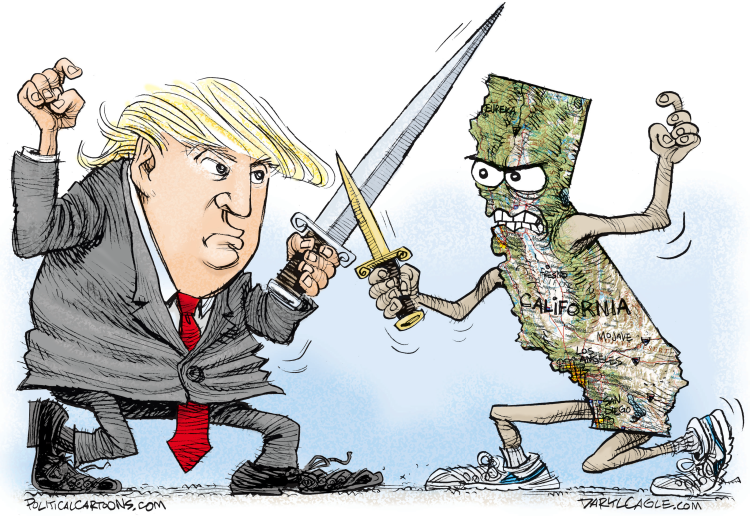
Here’s my recent cartoon about California battling President Trump. These Trump times are making trouble for cartoonists, too.
Here’s my cartoon in this morning’s Los Angeles Daily News ...
I used to see my cartoons in The Daily News regularly – not anymore. The Daily News is part of a group of about a dozen conservative-leaning papers called the Southern California News Group (SCNG) that is run from a central editorial command post at The Orange County Register. The SCNG papers redesigned their editorial pages to eliminate the traditional spot for a daily editorial cartoon (they run the smaller, conservative comic strip “Mallard Fillmore” on their editorial pages). My cartoon is the only editorial cartoon in The Daily News today, and likely the only editorial cartoon in all of the SCNG papers this week (I haven’t checked each paper; this is an educated guess).
The Los Angeles area is now an editorial cartoon desert. The Los Angeles Times (which has a rich tradition of editorial cartooning including decades with three time Pulitzer winner, Paul Conrad) runs only one editorial cartoon per week; on Fridays they run a David Horsey cartoon. David was hired by the Times’ online division as a columnist who also draws cartoons. In the past the Times ran a syndicated editorial cartoon every day.
Cartoonists hear a lot about editorial cartoonists losing staff jobs, but we don’t hear much about newspapers dropping syndicated editorial cartoons; this plague is accelerating as American newspaper editors are becoming more vocal in pushing back against editorial cartoons.
A conservative Pennsylvania newspaper, The Butler Eagle, recently created some buzz among cartoonists by leaving their regular cartoon spot blank as a protest, because the editor couldn’t find a cartoon that he liked. Most newspaper editors are conservative, serving red-state rural and suburban Trump voters who push back against Trump-bashing cartoons. These conservative editors complain loudly and often that there are no “pro-Trump” cartoons. Our little syndicate has been fielding many of these calls from editors in recent days. It is even more difficult for newspapers like The Butler Eagle, which doesn’t subscribe to CagleCartoons.com and doesn’t have much diversity of cartoons to choose from because of their poor choices of syndicate vendors. Even with our wider offering, we have very few cartoons that could be described as “pro-Trump”.
Editorial cartooning is a negative art. Supportive cartoons are lousy cartoons. I don’t know of any professional cartoonists who would describe themselves as “pro-Trump,” but I also don’t know cartoonists who would say that they were “pro-Obama,” “pro-Bush” or “pro-Clinton.” A good editorial cartoonist dislikes everybody. We attack whoever is in power. We draw what the pundits are talking about on cable news: all Trump, all the time. Editors are coming off of eight years of cartoonists criticizing Obama; now that the cartoonists are focused on Trump, the editors in red-state Trumpland are grumpy.
We’ve gotten some calls from other media searching for pro-Trump cartoons online, asking us where to find them. One TV news outlet wanted to have a roundtable discussion between pro and anti-Trump cartoonists; they had searched the Web and found cartoons by amateur cartoonists posting “pro-Trump” cartoons on their own blogs. In repeated conversations, I explain the difference between professional cartoonists whose work is published by others and amateurs who post on their own social media accounts – but it seems that the distinction between professionals and amateurs has been lost. Sadly, this is happening as respect for all professional journalists is in decline while president Trump bashes the media endlessly.
Sometimes I get emails from college students who are studying editorial cartoons; they often ask the same questions so I thought I would post this recent response I wrote to a student.
Hi James,
Your friends who think editorial cartoons are a dying art form should be told that editorial cartoons are more important around the world than ever before, and with the internet we have a far larger audience than our predecessors who were limited to print.
1. How many hours of research go into each of your cartoons?
Sometimes I’ll look for photo reference for the art, which doesn’t take long. You can see the whole process in real time by looking at my videos on DarylCagle.com. I live-stream on Twitch when I draw each cartoon now. Each cartoon takes about six hours.
2. How much time do you spend reviewing the news everyday?
I usually read two or three newspapers a day and watch cable TV news. Probably three hours a day. I wouldn’t call this “research” and it isn’t related to a particular cartoon.
3. What are two things that make you different from other cartoonists?
The biggest difference for me is that I have more freedom than most cartoonists. I own and run my syndicate (CagleCartoons.com, PoliticalCartoons.com, CagleWorld.com) so I don’t have an editor or a publication of record. My cartoons are distributed to about 850 subscribing newspapers, including about half of America’s daily paid-circulation newspapers. I don’t have to draw on the topic of the day as most cartoonist do, and I can maintain an irregular schedule, drawing on topics when a cartoon is needed. I don’t have to draw about the weather and celebrity obituaries as I did when I had an editor. The two differences: more freedom, no editor.
4. Who is your favorite person to portray?
Right now both Hillary Clinton and Donald Trump are gifts to cartoonists.
5. What experiences do you gain in traveling and how does traveling affect your work?
Editorial cartoons are much more important and more highly regarded internationally than they are in America. I am inspired by my brave colleagues around the world and it is great fun to meet them – especially those who put themselves at risk with their cartoons. In most of the world a cartoonist can’t draw the president of his own country or he’ll be fired, sued, beaten, jailed or killed. Friends of mine have been jailed by their governments and murdered by terrorists because of their cartoons. I enjoy the best press freedoms in the world in America. I have it easy – I only get attacked by hackers.
6. If you could give one piece of advice to someone looking at a career as a political cartoonist what would it be?
It is the same advice I would give to any aspiring, young journalist. Newsroom jobs are in decline. New journalists and cartoonists need to create a place where their work is seen by a loyal audience on the Web; they need to develop a reason why their voice is important for their audience. Journalists have to be entrepreneurs now. The days of getting a job at a newspaper and having a big publisher take care of your career are gone. There are more opportunities now, and it is simplistic to look at the decline in employee jobs as a decline for the cartooning profession. It is a big, exciting new world out there.
I have more freedom and a much bigger audience now that I have not been working for a newspaper for over sixteen years. There is no single path for everyone, as there was in the days when making a career meant applying for a job at a newspaper.
About your project … Think of editorial cartoonists as columnists who speak with images. We rarely see students analyzing columns because it is assumed that the columnist has clearly said what he meant to say. Cartoonists depend on their readers already knowing the news. Unlike columnists, we don’t convey facts; we convey simple, visual arguments. People cut the cartoons out to stick them on their fridge; they don’t do that with columns. Images are more powerful than words.
Cartoons are often analyzed by students because cartoons are on state mandated, AP Social Studies tests in 8th and 11th grade, in all 50 states, and teachers “teach to the test.” High school kids typically don’t think much about the news and often don’t have the background to understand what political cartoonists are drawing about. Cartoonists strive to make their points clearly, so the idea of editorial cartoons as puzzles that need to be solved and need an explanation or analysis is disappointing. If a cartoon needs to be explained, it is a poor cartoon or, more often, the reader is not well informed.


 Our troubled editorial cartooning profession has been losing employee positions in roughly the same proportion as all newsroom jobs lost over the past couple of decades. Journalism has become a freelance profession, and so has editorial cartooning. Three of our CagleCartoonists recently lost their jobs,





 Sometimes I’ll look for photo reference for the art, which doesn’t take long. You can see the whole process in real time by looking at my videos on