It seems that we get news of editorial cartoonists being laid off from newspaper jobs every couple of weeks, but it is unusual to hear of a cartoonist resigning from a rare newspaper job.
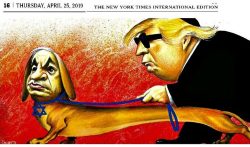
This week, our own Stephane Peray resigned from his job as the editorial cartoonist for the “Arab News” newspaper – a major daily newspaper in Saudi Arabia. Here is his letter of resignation, along with some of his cartoons that could not or would not run in Saudi Arabia. Some samples of Stephff’s cartoons about Saudi Arabia are below
–Daryl
To the management of the Arab News and to my readers, from Stephane “Stephff” Peray,
I’ve been very happy to work for the past 10 years with the Arab News, the leading daily English language newspaper in Saudi Arabia. Today I made a decision to resign with the newspaper because, since the Khashoggi scandal, I have a problem with the moral issues involved with the cartoons that are allowed to reprinted in Saudi Arabia.
Of course, my editors at the Arab News are not responsible for the war in Yemen, or for the assassination of a Saudi dissident journalist, still I face a difficult dilemma in deciding if I should continue to work with any media in Saudi Arabia.
For the past months, for obvious reasons, the Arab News couldn’t use any of my cartoons that were relevant to the Khashoggi affair and couldn’t publish any of my cartoons that relate to the war in Yemen – a war that killed thousands of innocent Yemeni children. In recent days, the Arab News cannot use any of my cartoons about the Saudi teenage girl, Rahaf, who escaped from Saudi Arabia and asked for asylum in Australia.
Sometimes I draw cartoons about my French government that has no problem with selling weapons to the Saudi government, exposing the double standard of western countries when it comes to choosing between human rights and lucrative defense contracts. If I keep publishing cartoons in a Saudi newspaper that will never publish any controversial cartoons, am I not guilty of hypocrisy myself?
I am just a cartoonist. I do not earn much money and taking the decision to resign from the Arab News was painful because I need the income, but I firmly believe that I must resign.
So I tender my immediate resignation from my collaboration with Arab News and ask my editors to please accept my apologies for any inconvenience I am causing to them by my abrupt departure. Please understand this has nothing to do with editors at the Arab News.
Best,
Stephff


I’ll give a lecture at California State University Northridge (CSUN) next Monday (November 20th) from 4:30pm to 6:00pm at Manzanita Hall Room 213, on the west side

of campus. It is free, but visitors need to buy a parking pass at an information booth or at a kiosk. Anyone can come who wants to come.
This is being put on by the University’s student SPJ chapter; their journalism professor, Stephanie Bluestein, is my local Los Angeles SPJ Chapter Chairman. I’ll give a PowerPoint presentation with lots of cartoons, and I’ll talk about my work, how my syndicate works, and issues for editorial cartoonists around the world. There will be a one-hour lecture with a half hour of Q&A. The map of where to go at CSUN is below.
I don’t get out much so this is a rare opportunity to see the real me. Don’t be shy. Come on by.

Our Bulgarian Cagle Cartoonist, my buddy Christo Komarnitski, started an editorial cartoon newspaper called “Prass Press” which roughly translates to
either “Whack newspaper” or “Pig newspaper” meaning the newspaper that “whacks the (government) pigsty in Bulgaria -the dirty dealings, hypocrisy and corruption.” If only Bulgarian readers could see a copy of the newspaper I’m sure they would enjoy it.
Alas, just like in the old communist days, when government authorities don’t like political cartoons, newspapers just “disappear”. More than 90% of the copies of Prass Press have been lost by the only distribution company in Bulgaria, which happens to be controlled by the Bulgarian government that the Prass Press criticizes.
Read more about Prass Press here: https://bnr.bg/en/post/100805939/who-swiped-the-circulation-of-the-paper-of-the-rude-cartoonists
See more of Christo’s cartoons on Cagle.com here: http://www.cagle.com/author/christo-komarnitski/
Cagle.com needs your support, please visit: http://cagle.com/heroes
Here’s a nice article by Dianne Hardisty, a former editor at the Bakersfield Californian newspaper, an excellent subscriber to our Cagle Cartoons newspaper package. She interviewed me and three of our cartoonists, Adam Zyglis, Rick McKee and Nate Beeler.

Editorial cartoons: Great antidotes for bloated egos
By Dianne Hardisty
You can almost hear the screams of editorial page editors: “Find me a pro-Trump cartoonist!”
Good luck finding a “pro-Trump” cartoonist of any political stripe, including conservative, these days.
“A real editorial cartoonist is not pro-anything,” explains Rick McKee, a staff cartoonist with The Augusta (Ga.) Chronicle. His work is distributed to hundreds of newspapers around the country by the Cagle Cartoons syndicate.
“Editorial cartooning is a negative art. You may be more supportive of a certain point of view. But it’s criticism. You don’t want to be a cheerleader for any particular politician,” says McKee, who takes a conservative approach to most political issues.
Since Donald Trump was sworn in as president in January, editorial cartooning has kicked into high gear. And the new president’s combative nature, compulsive tweeting, political stumbles and thin skin have been the gifts that keep on giving to the nation’s cartoonists.

“It’s like drinking from a fire hose. It’s overwhelming,” says Nate Beeler, a conservative staff cartoonist with The Columbus (Ohio) Dispatch, whose work also is distributed by Cagle Cartoons.
“You can’t keep up,” says Adam Zyglis, who draws five cartoons a week for The Buffalo (NY) News and is the president of the Association of American Editorial Cartoonists. “You have to prioritize. You could easily do two, three, maybe more cartoons a day.”
And on the receiving end of this avalanche of cartoons are the nation’s opinion editors, who often struggle to give political “balance” to the commentary they present to their readers.
In emails and calls to their colleagues, editors have been searching for conservative – yes, especially pro-Trump – columnists and cartoonists. Some also are looking for columnists to explain how the largely ignored people who live in the fly-over states were able to surprise all those “brilliant” political pundits by electing Trump.
Editors are looking for the Holy Grail of “balance” for their pages. And the job is made tougher in this Trump era by 2016 voters handing control of Congress, as well as the White House, to the Republican Party.
“Power corrupts, no matter who is in power,” says the conservative Beeler, explaining that it is his job “to take on people in power.” And with few exceptions, those people will be the Republican politicians, who now have absolute power.
This imbalance has happened before, when absolute political power has shifted to one political party or another after an election. But it seldom lasts. Usually within an election cycle or two, fickle voters return to divided government, splitting up power between parties in Congress and the White House.

But in the meantime, the life of an opinion editor can be pure hell, with readers screaming about what they perceive is bias in the newspaper’s sometimes lopsided criticism of those in power.
Good luck achieving some ideal concept of balance in an opinion section, when there is little balance of power in the halls of government. And with the election of Trump, there is also no shortage of criticism.
The president’s critics are not confined just to the Democrats, snotty cartoonists and the “dishonest media.” They include many people in his own political party.
With Trump showing no signs of mellowing and a small group of advisors in the White House egging him on, the fire-hose-flow of controversies shows no sign of abating, and neither does the flow of cartoons that criticize and ridicule the president.
During last summer’s presidential campaign, Daryl Cagle, a cartoonist, who worked for more than a decade drawing The Muppets, and was later on the staff of The Honolulu Advertiser and MSNBC before creating his Cagle Cartoons syndicate, wrote prophetically about how a Donald Trump or Hillary Clinton administration would look in cartoons.
“Cartooning is a negative art and a supportive cartoon is a lousy cartoon. Hillary is a rich character that we have known for decades. There is a grand history with Hillary and Bill Clinton that gives us many more clichés for a broader cartoon palette.

“If Trump loses in November, we should enjoy four years of great Hillary cartoons. If Trump wins in November, the Trump-monster cartoon-apocalypse will continue. God save us.”
And, indeed, it has continued. In fact, Trump seems to be invigorating cartoonists.
“We have a newfound mission,” Zyglis says. “What we do is important. It always has been. But there is more immediacy today. This is a time we are needed the most.”
“Editorial cartooning becomes more important as democratic institutions are threatened,” Zyglis says, noting the insults Trump throws at just about every institution that stands in his ways, including the courts, intelligence agencies and news media.
“It is clear how much he despises the media. And in authoritarian regimes, satire is the first target. Look how ‘Saturday Night Live’ gets under Trump’s skin. An editorial cartoon is just a single panel form of a ‘Saturday Night Live’ skit.”
But Beeler is confident his colleagues will stand strong and prevail against Trump’s attacks because “editorial cartoons are great antidotes to bloated egos.”
Dianne Hardisty is a former editorial page editor, who now writes about the media and politics.
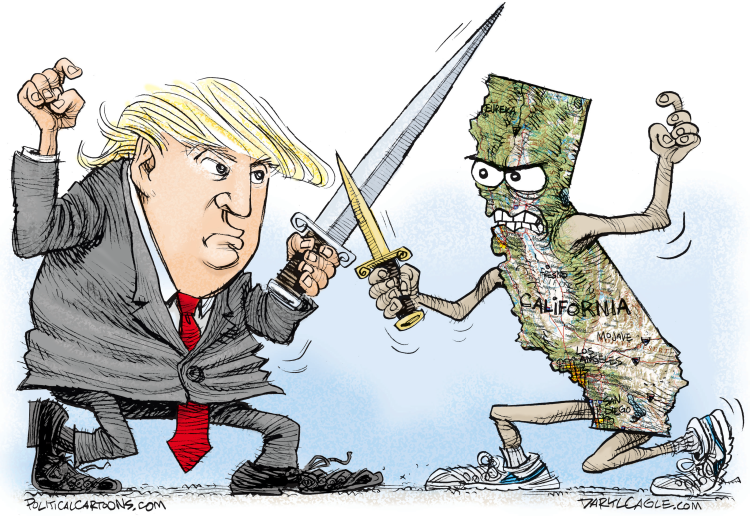
Here’s my recent cartoon about California battling President Trump. These Trump times are making trouble for cartoonists, too.

Here’s my cartoon in this morning’s Los Angeles Daily News ...

I used to see my cartoons in The Daily News regularly – not anymore. The Daily News is part of a group of about a dozen conservative-leaning papers called the Southern California News Group (SCNG) that is run from a central editorial command post at The Orange County Register. The SCNG papers redesigned their editorial pages to eliminate the traditional spot for a daily editorial cartoon (they run the smaller, conservative comic strip “Mallard Fillmore” on their editorial pages). My cartoon is the only editorial cartoon in The Daily News today, and likely the only editorial cartoon in all of the SCNG papers this week (I haven’t checked each paper; this is an educated guess).
The Los Angeles area is now an editorial cartoon desert. The Los Angeles Times (which has a rich tradition of editorial cartooning including decades with three time Pulitzer winner, Paul Conrad) runs only one editorial cartoon per week; on Fridays they run a David Horsey cartoon. David was hired by the Times’ online division as a columnist who also draws cartoons. In the past the Times ran a syndicated editorial cartoon every day.
Cartoonists hear a lot about editorial cartoonists losing staff jobs, but we don’t hear much about newspapers dropping syndicated editorial cartoons; this plague is accelerating as American newspaper editors are becoming more vocal in pushing back against editorial cartoons.
A conservative Pennsylvania newspaper, The Butler Eagle, recently created some buzz among cartoonists by leaving their regular cartoon spot blank as a protest, because the editor couldn’t find a cartoon that he liked. Most newspaper editors are conservative, serving red-state rural and suburban Trump voters who push back against Trump-bashing cartoons. These conservative editors complain loudly and often that there are no “pro-Trump” cartoons. Our little syndicate has been fielding many of these calls from editors in recent days. It is even more difficult for newspapers like The Butler Eagle, which doesn’t subscribe to CagleCartoons.com and doesn’t have much diversity of cartoons to choose from because of their poor choices of syndicate vendors. Even with our wider offering, we have very few cartoons that could be described as “pro-Trump”.
Editorial cartooning is a negative art. Supportive cartoons are lousy cartoons. I don’t know of any professional cartoonists who would describe themselves as “pro-Trump,” but I also don’t know cartoonists who would say that they were “pro-Obama,” “pro-Bush” or “pro-Clinton.” A good editorial cartoonist dislikes everybody. We attack whoever is in power. We draw what the pundits are talking about on cable news: all Trump, all the time. Editors are coming off of eight years of cartoonists criticizing Obama; now that the cartoonists are focused on Trump, the editors in red-state Trumpland are grumpy.
We’ve gotten some calls from other media searching for pro-Trump cartoons online, asking us where to find them. One TV news outlet wanted to have a roundtable discussion between pro and anti-Trump cartoonists; they had searched the Web and found cartoons by amateur cartoonists posting “pro-Trump” cartoons on their own blogs. In repeated conversations, I explain the difference between professional cartoonists whose work is published by others and amateurs who post on their own social media accounts – but it seems that the distinction between professionals and amateurs has been lost. Sadly, this is happening as respect for all professional journalists is in decline while president Trump bashes the media endlessly.
Sad times for our profession continue.
Sometimes I get emails from college students who are studying editorial cartoons; they often ask the same questions so I thought I would post this recent response I wrote to a student.
Hi James,
1. How many hours of research go into each of your cartoons?
Sometimes I’ll look for photo reference for the art, which doesn’t take long. You can see the whole process in real time by looking at my videos on DarylCagle.com. I live-stream on Twitch when I draw each cartoon now. Each cartoon takes about six hours.2. How much time do you spend reviewing the news everyday?
3. What are two things that make you different from other cartoonists?
4. Who is your favorite person to portray?
Right now both Hillary Clinton and Donald Trump are gifts to cartoonists.
5. What experiences do you gain in traveling and how does traveling affect your work?
Editorial cartoons are much more important and more highly regarded internationally than they are in America. I am inspired by my brave colleagues around the world and it is great fun to meet them – especially those who put themselves at risk with their cartoons. In most of the world a cartoonist can’t draw the president of his own country or he’ll be fired, sued, beaten, jailed or killed. Friends of mine have been jailed by their governments and murdered by terrorists because of their cartoons. I enjoy the best press freedoms in the world in America. I have it easy – I only get attacked by hackers.
6. If you could give one piece of advice to someone looking at a career as a political cartoonist what would it be?
It is the same advice I would give to any aspiring, young journalist. Newsroom jobs are in decline. New journalists and cartoonists need to create a place where their work is seen by a loyal audience on the Web; they need to develop a reason why their voice is important for their audience. Journalists have to be entrepreneurs now. The days of getting a job at a newspaper and having a big publisher take care of your career are gone. There are more opportunities now, and it is simplistic to look at the decline in employee jobs as a decline for the cartooning profession. It is a big, exciting new world out there.
I have more freedom and a much bigger audience now that I have not been working for a newspaper for over sixteen years. There is no single path for everyone, as there was in the days when making a career meant applying for a job at a newspaper.
About your project … Think of editorial cartoonists as columnists who speak with images. We rarely see students analyzing columns because it is assumed that the columnist has clearly said what he meant to say. Cartoonists depend on their readers already knowing the news. Unlike columnists, we don’t convey facts; we convey simple, visual arguments. People cut the cartoons out to stick them on their fridge; they don’t do that with columns. Images are more powerful than words.
Cartoons are often analyzed by students because cartoons are on state mandated, AP Social Studies tests in 8th and 11th grade, in all 50 states, and teachers “teach to the test.” High school kids typically don’t think much about the news and often don’t have the background to understand what political cartoonists are drawing about. Cartoonists strive to make their points clearly, so the idea of editorial cartoons as puzzles that need to be solved and need an explanation or analysis is disappointing. If a cartoon needs to be explained, it is a poor cartoon or, more often, the reader is not well informed.
Daryl
Here’s my long interview with Bob Andelman (Mr. Media) about my work, the editorial cartooning business and editorial cartoons around the world.
This is a cartoon I was working on when I did the interview at my drawing table.

I was pleased to learn that my talented, cartoonist buddy, Bill Day, just got a full time job as an editorial cartoonist for FloridaPolitics.com. New jobs for editorial cartoonists are rare these days, and full time jobs with Web site firms are even more rare, so this is great to see!
Kudos to Peter Schorsch of FloridaPolitics.com for being a brave trendsetter who sees the need and value of having a staff cartoonist and local cartoons. Bill will be drawing about Florida issues, at least five cartoons a week, in addition to illustrations for the site.
Bill is formerly the cartoonist for the Memphis Commercial-Appeal and the Detroit Free-Press. I syndicate Bill’s cartoons to newspapers and Bill’s work will continue to appear here on Cagle.com.

Correction: 4:20pm. Bill tells me he hasn’t moved to Florida, he’s still in Memphis. OK. Congrats again, Bill.

Like blaming a rape victim for her “provocative dress,” many press pundits blame the Charlie Hebdo cartoonists (and the Danish cartoonists before them) for crossing “red lines,” and inviting trouble. In the past few days the small community of American editorial cartoonists have been getting calls from their local media, asking for comments about self-censorship and what subjects we should be forbidden to draw in a free society.
Political cartoonists have no clear red lines, but we are certainly censored. Cartoonists are a macho bunch; we want to draw provocative cartoons, bashing the reader on the head with the most powerful images possible. Editors see cartoonists as bomb throwers, to be reigned in.
There are about fifteen-hundred daily, paid circulation newspapers in America, and less than fifty cartoonists have jobs working for those papers, the vast majority of the papers use “syndicated” cartoons, culling a cartoon or two each day from a large menu of available, national cartoon options. Newspaper editors have been growing more timid, wanting to avoid reprinting anything that might offend a declining readership; they usually avoid printing the most hard-hitting cartoons. The result is that American editorial cartoons are tame compared to cartoons around the world – and in France.
Yesterday, one of the cartoonists I syndicate, David Fitzsimmons of The Arizona Daily Star in Tucson, drew a cartoon depicting the Prophet Muhammad that we delivered to our 850 subscribing newspapers. Editorial cartoons depicting the Prophet Muhammad are not unusual. We were flooded with calls from editors questioning our wisdom in posting the cartoon, and asking if other editors were running it before deciding to run it themselves.
Cartoons are more powerful than words. Readers don’t cut columns out of the newspaper to hang on their fridges. Editors quickly learn that cartoons generate more angry e-mail than the same ideas expressed in words. Editors prefer cartoons that are like Jay Leno jokes, about a topic in the news, but expressing no real opinion. If we want our work to be reprinted, cartoonists have to consider drawings that timid editorial-gatekeepers will let pass. This is the censorship of the marketplace.
I know cartoonists who insist on drawing offensive cartoons with four letter words; they complain that the market is unfair for rejecting them. Tame cartoonists are sometimes derided by our macho colleagues for selling-out to syndication. My French cartoonist friends joke about American cartoonists being prudes. For example, the French draw bare breasts in their cartoons frequently; American cartoonists can’t do that if they want their cartoons to be reprinted in U.S. newspapers -a bare-breasted fact that amuses my French colleagues.
Our censorship of the marketplace in a free society is nothing like government censorship, a concept that is difficult for the much of the world to understand or appreciate. Around the world editorial cartooning is a dangerous profession, and censorship is real. Cartoonists in China self-censor, never drawing the Chinese president; cartoonists in Cuba have never drawn Fidel Castro. Our cartoonists in Singapore tell me they can draw whatever they want, as long as it isn’t about Singapore. Government censorship is so common around the world that calls for red lines seem reasonable to many.
Editorial cartoons are more important around the world than they are in America. Charlie Hebdo is a top magazine in France; it is on newsstands everywhere; the top French cartoonists vie to be on the pages of Charlie Hebdo and a second, satirical paper, Le Canard Enchainé (the “Unchained Duck”). Sadly, there are no similar publications on American newsstands. Visitors to Cairo are greeted by dozens of newspapers, most with editorial cartoons on the front page. Editorial cartooning has a much stronger tradition in the romance language and Arabic speaking countries where editorial cartoonists are among the most influential voices in society. It is no surprise that editorial cartoons are the flashpoint of a clash of civilizations.
The calls for cartoonists to self-censor are absurd. In a free society we will always have a broad range of voices. Extremist cartoonists are effectively censored when there are no publications willing to convey their rants – and no audiences who want to see their offensive work. Cartoonists are constantly pushing the limits, with editors guarding the red lines, pushing back.
In France, the heroic Charlie Hebdo cartoonists lampooned issues that are important to their French audience, with Muslim extremists at the top of their lampoon-list. Cartoonists respond to intolerance with ridicule. Typically, timid editors respond to intolerance with too much restraint.
There should be no “red lines,” just good judgment. Editors should show more bravery. The cartoonists are already brave; we need more editors who cover our backs.
Stop asking cartoonists about red lines. Ask editors about red lines. Ask the editors to be more brave.

I had great fun at the European editorial cartoonists convention in St Just le Martel France the last two years and I’m going again this year. It is a public event in the small French town, and any fans who would like to visit with the scores of attending editorial cartoonists are welcome to come. The cartoonists often sit at drawing tables and are happy to chat and do drawings for visitors.


St Just le Martel is the patron saint of a little French town near Limoges; his bones are housed at an ancient little church in town. The story goes that little St Just was walking along one day when God asked him to throw his hammer (martel); when the hammer landed, water squirted out of the ground. God told little St Just to build a church on the spot, founding the little town. That’s an adult St. Just (right) breaking his dinnerplate halo with his martel, in an image that the town seems to have adopted as a logo (I don’t know who the artist was on this one). That’s the church that houses his bones at the left.
The tiny town opens itself up to editorial cartoonist from around the world every year at the end of September. The townsfolks put the cartoonists up in their homes and get together to prepare giant meals for the cartoonists and what looks like the whole town through the “Salon.” And the little town has built a big, nice cartoon museum (below). It is hard to imagine any little town in America doing something like this (although it looks like Kenosha, Wisconsin and Marceline, Missouri may be headed in that direction).


There is a contingent of Australian cartoonists attending this year, along with six American cartoonists that are coming with me: Steve Sack, Rick McKee, Adam Zyglis, Monte Wolverton and Nate Beeler. We’re doing exhibitions of American Views of Putin and Ferguson Missouri; I expect the Australian cartoonists will have an exhibition of Aussie cartoons.
I did the poster for this year’s Salon (right, click here to see the sketch and a large version of the poster). The Salon/festival runs over two weekends from September 27th through October 5th. The first weekend they give their “Humor Tendre” (tender humor) award to someone like a children’s book illustrator who draws nice, sweet cartoons; the award consists of a live sheep. The week between the weekends can be a bit slow, but some cartoonists hang out for the week between the two weekends.
The second weekend, when most of the editorial cartoonists attend, they give the “Humor Vache” (cow humor, or harsh humor) award to a more satirical, caustic cartoonist. I won the cow last year, which is why I did the poster this year; there seems to be a tradition of the cow winner doing the poster for the following year. See me with my charming prize, Josette the cow, at last year’s event here.
St Just le Martel is way out in the French boondocks, cow country, and they are proud of their cows. The cow has become a symbol for the Salon/festival – the Limoges cow is always brown, like Josette. Here are some more posters from recent Salons …


Here I am with my cow, Josette. I’m holding the St. Just porcelain statue depicting their logo that they give to grand prix winners.
I just got back from the grand editorial cartooning festival in St. Just le Martel, France where I won the grand prix, the “Prix de l’humor Vache” award, which was an actual cow, named Josette.
The “Salon de St. Just, ” in its 32nd year, draws cartoonists from around the world to a tiny town near Limoges. The townspeople have adopted the cartoonists and hold a party that stretches over two weekends, in a grand cartoon museum they built in the middle of cow country. Most of the cartoonists stay in the homes of volunteer villagers – the entire event is put together by townpeople Cartoonists usually come for only one weekend of the festival, splitting the crowd between what becomes two different weekend groups of roughly 120 cartoonists each.
This was my second “Salon,” last year I went with our knuckle-dragging, conservative, “Tea Party” cartoonist, Eric Allie, who was a strange beast to the French. This year I went with three liberal cartoonists, Pat Bagley of the Salt Lake Tribune, Steve Sack of the Minneapolis Star-Tribune, and Bob Englehart of the Hartford Courant for three days of open bar and schmoozing with our international colleagues.
Here I am with my Cagle Cartoons colleagues, dubbed “Cagle Cowboys”, from left, Josette, Pat Bagley, Me, Bob Englehart and Steve Sack below.
My festival friends tell me that a cow is usually a placid animal, but sometimes the cow will get annoyed and give a swift, painful kick as a surprise to an unlucky bystander; this contributes to the idea that the cow is a little sneaky, nasty and unpredictable. The “Prix de l’humor Vache,” the grand prize they gave me, is described as an award for “caustic humor.” “Humor Vache” (funny cow) rhymes with “Amour Vache” (love cow, or more accurately “rough love”) a French idiom for a love affair that is nasty, consisting of harsh words and arguments. In France, to refer to someone as a “vache” (cow) is a little bit nasty. In contrast, on the first Saturday of the Salon, they give out the “Humor Tendre” (Tender Humor) award, which is a sheep, given to a sweet cartoonist such as a children’s book illustrator.
The Limoges area is proud of their cows, which are raised for beef and are all a warm brown color. The cow is the symbol and mascot of the Salon. Every year, the “Prix de l’humor Vache” cow is named “Josette” and is actually given to the winning cartoonist. At the ceremony, the mayor of St. Just, Gerard Vandenbroucke, awarded Limoges porcelain cows to my three American compatriots, dubbing them “Cagle’s cowboys.” Bob, Pat and Steve, who can also claim to have won cows (although, not real cows) took their little cows around to all the other cartoonists at the Salon to sign; it was charming.
Typically, the winning cartoonist is expected to take a cash award (I still don’t know how much) in lieu of actually taking delivery of the real Josette, who would be difficult to check on a plane and would likely be an unpleasant roommate in my tiny, Nashville apartment. But, they make it clear that the cartoonist really won a cow and could actually take the cow if he or she chooses to, and there are stories of cartoonists in past years choosing to take the cow. I’m told that are some amusing movies of a past winner taking his cow to Paris, trying to bring the cow on the Metro, and taking the cow up the Eiffel Tower. If anyone can find these movies online, I’d love to take a look.
Part of winning the grand prize cow is the obligation to do the art for the poster for the next Salon. The poster this year featured a lovely Degas-like ballerina cow. The festival people then dress a cow sculpture, in the entry to the museum, to match the cow on the poster. My plan is to give the cow on next year’s poster a very elaborate costume that will be a unique challenge for a St. Just volunteer to create for the cow statue. Right now, I’m thinking of doing the poster cow as Marie Antoinette with a huge, elaborate, flowing gown.
Here’s Bob Englehart with the cow statue at the entrance to the exhibition. The cow is dressed to match the poster which is a ballerina this year. Next year I’ll be doing the poster and I plan to put the cow in a very elaborate costume that will be a challenge for St. Just’s volunteer seamstresses.
The whole event in St. Just is a lovely boost for our beleaguered editorial cartooning profession which is suffering in France as it is here and around the world with newspapers declining everywhere. I’d love to see some of the great French attitude about the value of editorial cartooning rub off on other parts of the world, like America, which treats cartooning as a second class art form. I can’t imagine a whole town in the USA choosing to build a municipal cartoon museum, opening their homes, and pitching together to cook dinner for hundreds of editorial cartoonists – and, of-course, a nine day open bar would be unthinkable in America.
From left to right, Bob Englehart, Stave Sack, St. Just’s Mayor Gerard Vandenbroucke in the red shirt, me holding my “Prix de l’humor Vache” porcelain statue, Josette, and Pat Bagley in the lower right corner.
Below is a scan of the Limoges newspaper front page and interior story from the day after I had a cow.