The government is reopened and Democrats are being mocked for caving. Looks like everything is back to normal in Washington.
Our most-reprinted cartoon of the week was John Darkow’s perfect shutdown metaphor, comparing Democrats trusting Republicans to extend Obamacare subsidies to Lucy holding the football for Charlie Brown. I think we all know how this will end.
Our cartoonists covered a lot of ground this week, with popular cartoons about Veteran’s Day, Thanksgiving, and even the northern lights. I personally liked Rick McKee’s cartoon about the old woman who lives in a shoe, a lucky recipient of one of Trump’s 50-year mortgages. I wonder if she’s still making payments.
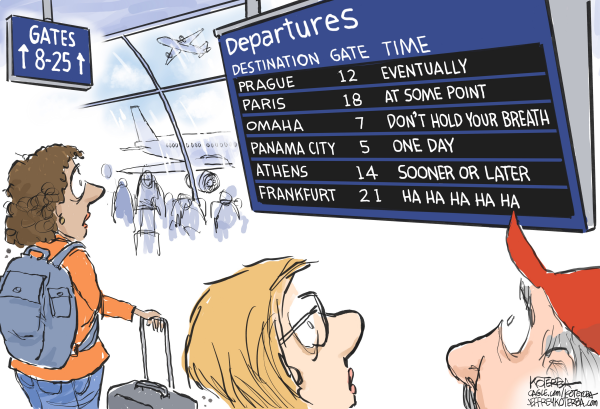
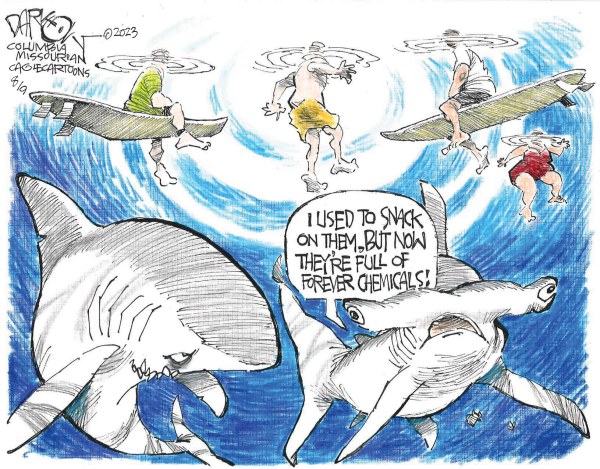
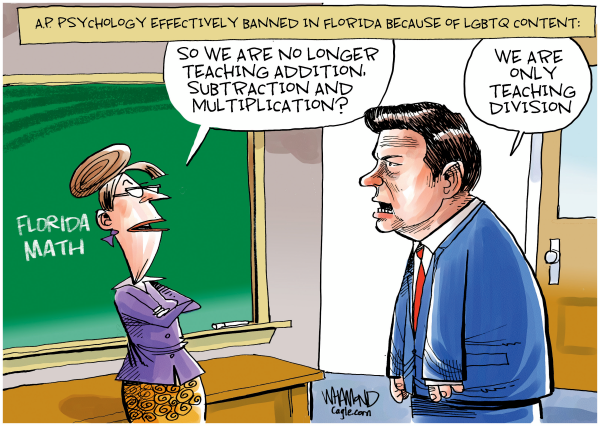
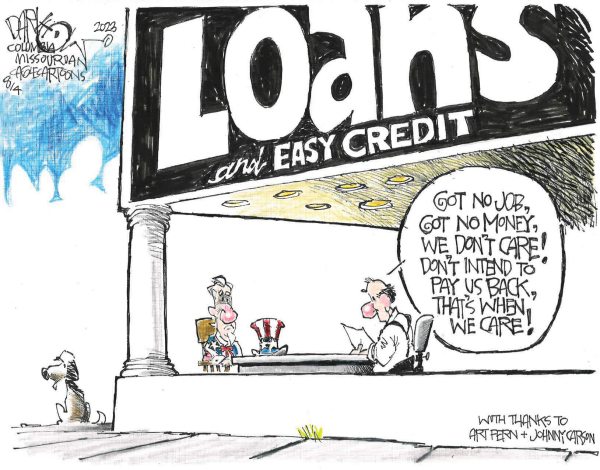
Here are our top ten most reprinted cartoons of the week:
As the government shutdown enters its sixth week, Republicans and Democrats don’t seem much closer to a solution both sides can agree on.
As Bob Englehart notes in his popular cartoon this week, we’re not listening to one another. The loudest, harshest voices dominate the discussion, with one side yelling at the other, as Gary McCoy depicted in his funny toon.
Hopefully the sweeping Election Night Democrats had this week loosens things up in Washington so a deal can get done before planes start falling from the sky. Our cartoonists don’t seem too optimistic about that.
Here are our top ten most reprinted cartoons of the week:
One problem I have with these videos is that I’m a one-man-band video crew, looking at the monitors to switch views, select cartoons and make adjustments as we go along, so I turn my head left and right, and I look down, and I rarely stare blankly into the camera as I should do. I look distracted. So I tried a new A.I. gizmo that adjusts my gaze to look into the camera. I watched the beginning of the video as I turned my head from side to side, but my stare remained on the camera, and I thought it looked good. This is a feature of an editing program I use, called “Descript,” and they call their A.I. “Overlord.”
Then, after I posted the video on YouTube, and I looked a little more closely, I noticed my eyes would sometime dart around, at one point rolling up into my head; poor Adam Zyglis had a twitchy right eye, and at one point is cross eyed. And some cartoons are googley eyed too.
This cartoon by Bart van Leeuwen made me laugh, at 35:10 into the video, the A.I. Overlord animated the eyes on Trump and Biden and it looks pretty funny. Take a look. At 44:47 into the video, this cartoon by Dave Granlund also gets strangely realistic, with moving eyes that reminded me of the mouths on the old Clutch Cargo show from 1960. I liked that show when I was five years old. It was creepy.
Even though you might think that Adam and I are occasionally having a stroke, I decided to leave this version of the video up without re-editing. I won’t be using the Overlord again.
Cartoonists who keep their eyes focused on A.I. are getting other headaches now. Here’s a cartoon by Bob Englehart that was recently stolen and redrawn with AI.
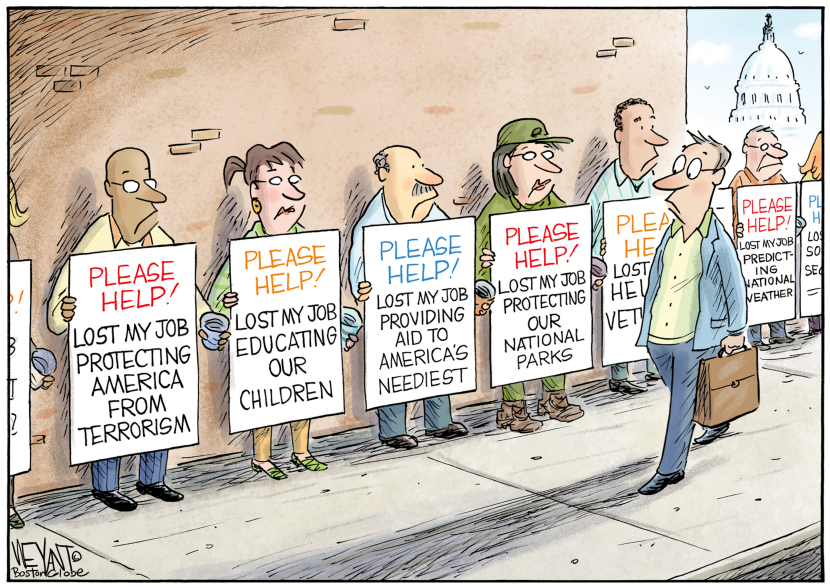
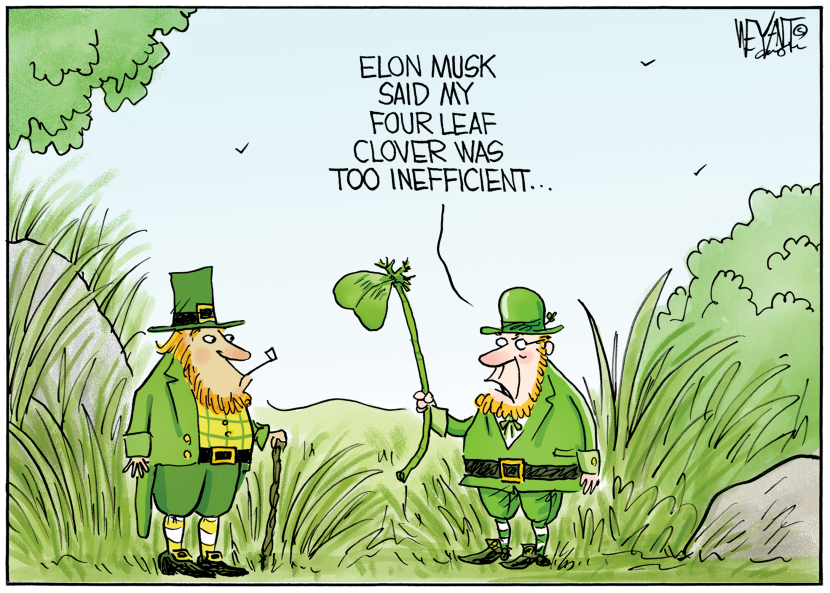
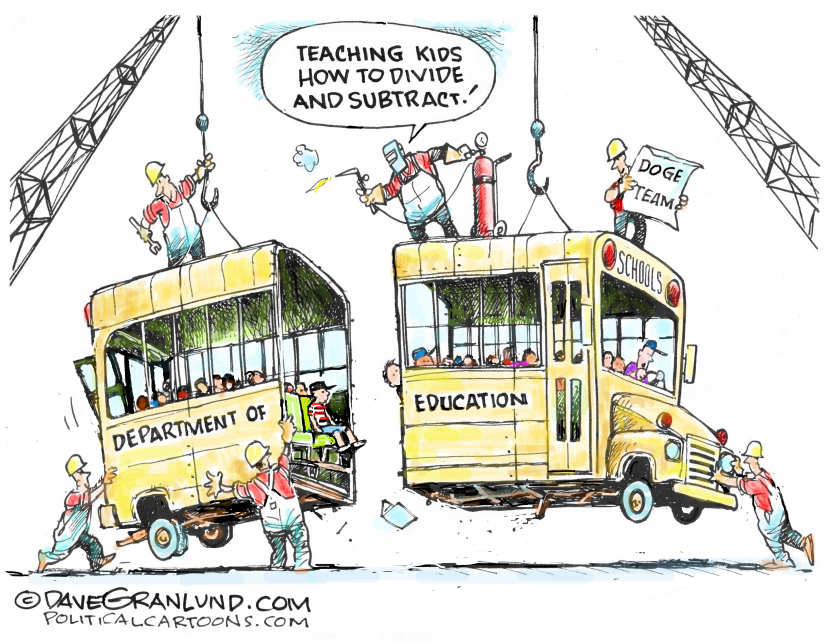
IRS agents. VA workers. Park rangers. Air traffic controllers. Social Security administrators. No one employed by the federal government appears safe with Elon Musk and his Department of Government Efficiency waiving a chainsaw across Washington.
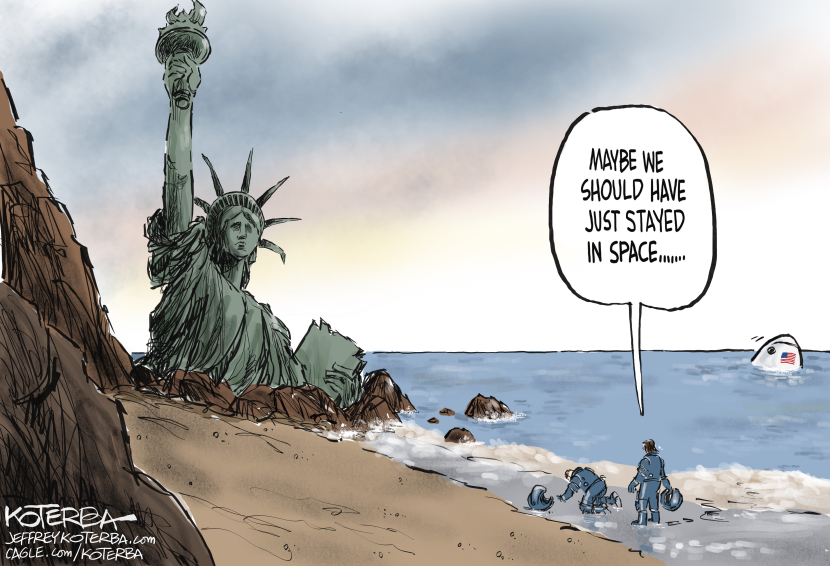
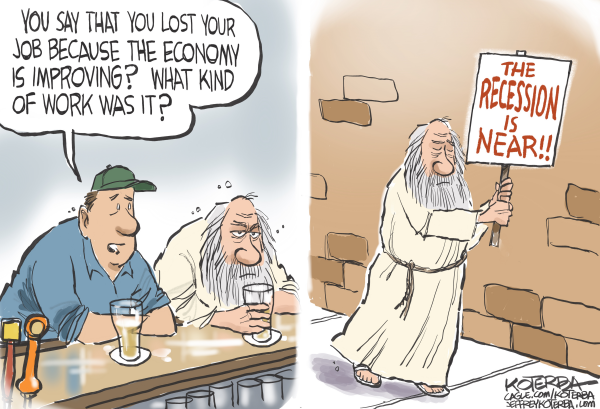
Our top two most-reprinted cartoons of the week come from Chris Weyant, and both mock Musk’s blunt and mistake-prone process of trimming the size of the federal workforce. I also enjoyed Jeff Koterba’s cartoon about astronauts returning home after being stuck on the International Space Station, only to find a “Planet of the Apes” scenario playing out in the U.S.
Here are our top ten most reprinted cartoons of the week:
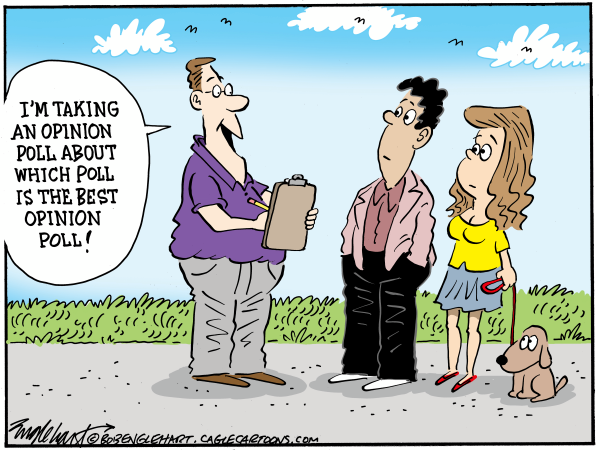
The first Republican presidential debate of the 2024 election cycle is later this month, and not a day goes by without the release of a new poll. Donald Trump has a wide lead over his fellow Republicans, Ron DeSantis continues to shed support, Mike Pence… well, the less said about his poll numbers, the better.
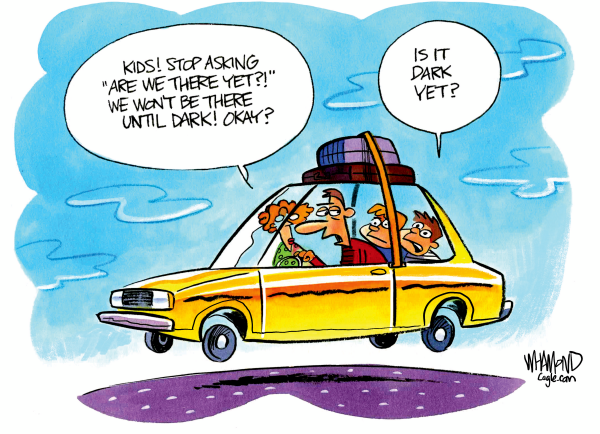
Bob Englehart had our most popular cartoon this week, a funny jab at the omnipresence of polling data as we crawl towards the election. It’s only going to get worse from here. –And WOW– Dave Whamond, Jeff Koterba and John Darkow each have THREE cartoons in the Top Ten, I can’t remember it ever happening that the Top Ten has only four cartoonists!
Here they are –the ones that newspaper editors liked best:
#1. Bob Englehart
See: Support Ukraine or Not? YouTube.com/@Caglecast Episode #22 with our anonymous, conservative cartoonist, Rivers, who doesn’t want the USA to support Ukraine.
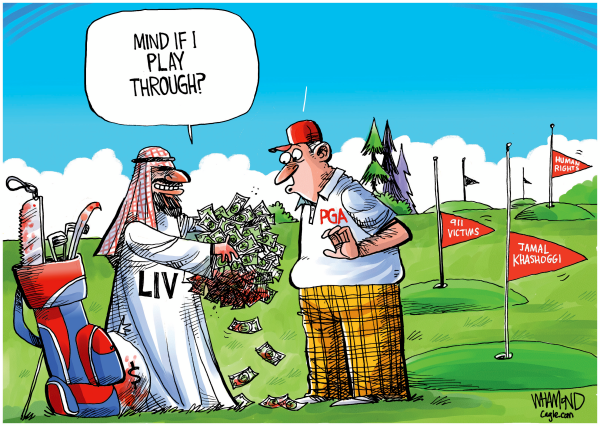
LIV Golf’s surprise merger with the PGA Tour continues to shock the sports world. Dave Whamond’s cartoon about new partnership – forged with Saudi money – was our most reprinted cartoon this week.
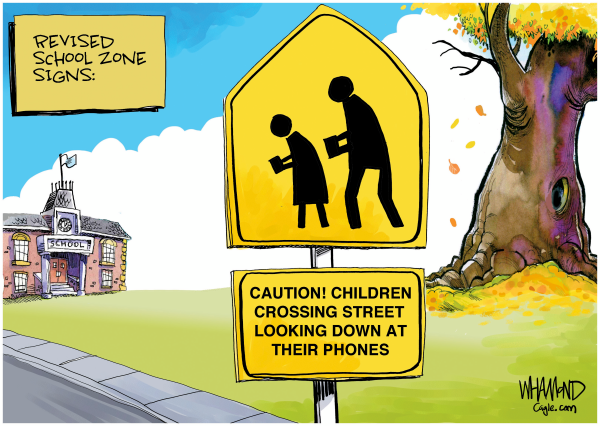
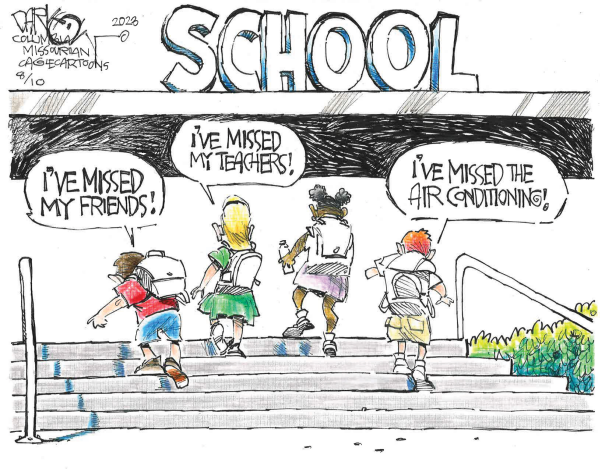
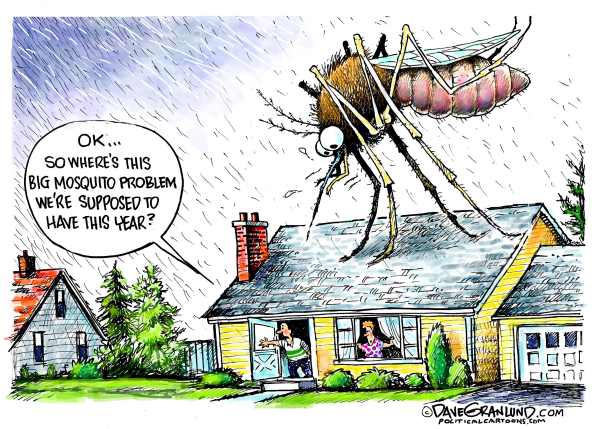
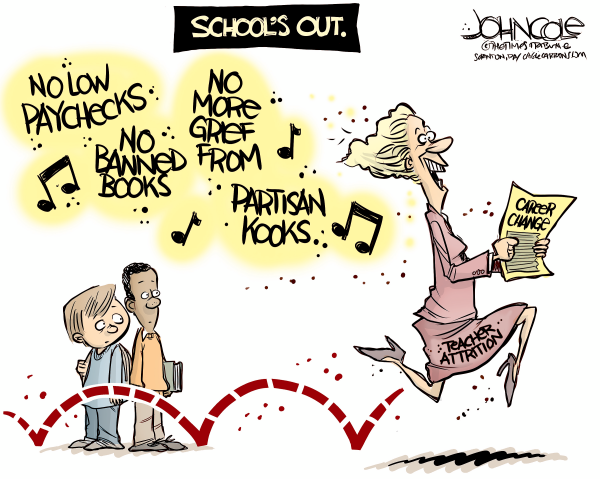
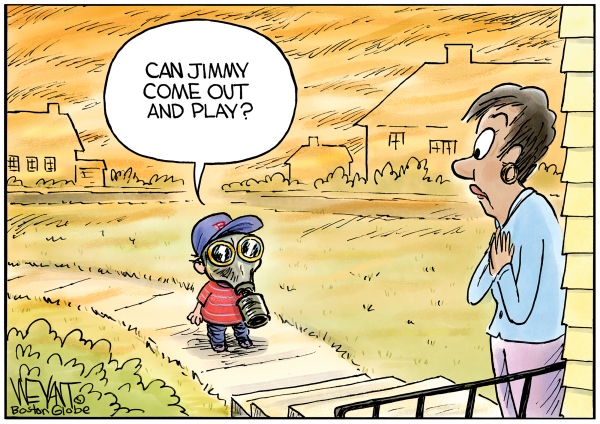
Other cartoons popular with editors this week riffed on a number of news topics ranging from orange skies in the Northeast to the pressure on teachers.
Here are our top ten most reprinted cartoons of the week:
We just added closed captioning and different language sub-titles on YouTube, and we’ll have that soon on CagleCast.com too! In this episode see me and our CagleCartoonists Jeff Koterba, Andy Singer, Rick McKee and our anonymous cartoonist, Rivers!
Here are Bob Englehart’s favorite cartoons of the past decade! For decades, Bob was the staff cartoonist for The Hartford Courant newspaper in Connecticut.
We need your support for Cagle.com (and DarylCagle.com)! Notice that we run no advertising! We depend entirely upon the generosity of our readers to sustain the site. Please visit Cagle.com/heroes and make a contribution. You are much appreciated!
I pitched the idea to Gannett of running collections of favorite cartoons of the decade every day in December, the last month of the decade, with a selection by a different cartoonist each day. We, along with USA Today, selected the CagleCartoonists we would invite to participate and we asked them each to choose their favorite cartoons from the past ten years. I submitted twenty-nine batches of cartoons, selected by each of twenty-nine of our CagleCartoonists. USA Today plans on showcasing their own Gannett employee cartoonists, Thompson, Marlette, Murphy and Archer, through Thursday, with our CagleCartoonists finishing out the month, starting this Friday with Pat Bagley.
USA Today started off their daily, decade slideshows today with their talented cartoonist, Mike Thompson, who also did the work of laying all of these collections out for The USA Today Network sites (that includes the individual Web sites for all of Gannett’s 100+ daily newspapers). Visit USA Today’s Opinion page online to see these every day this month. Click on each cartoon in each slideshow to see a full-screen, high-resolution version of each cartoon, which is very nice.
It is very difficult to select a small batch of cartoons to represent an entire decade!!
Getting twenty-nine CagleCartoonists to each select a decade of favorites was challenging. Obama certainly got shorted as many cartoonists are obsessed with Trump now. A couple of cartoonists selected only Trump-bashing cartoons, which made for a poor representation of the decade –but hey, the fact that the cartoonists chose their own favorites made this project interesting. Some cartoonists, who have been with us for less than ten years, had to dig into their personal archives to cover the whole decade, so some of the cartoons haven’t been seen on Cagle.com. New Yorker/Mad Magazine/graphic-novelist Peter Kuper joined CagleCartoons.com just a couple of months ago and had to dig up his whole collection from his magazine gag cartoon archives. Dave Whamond and Ed Wexler, who joined us more recently, reached into their vaults for some of their early-decade cartoons; Ed selected some from when he was regularly drawing for US News & World Report magazine. Mike Keefe and Bill Schorr came out of their recent retirements to contribute their selections of favorites.
I wouldn’t call these selections the “best” of the decade, they are just the artists’ choices. I also can’t say that they represent the decade well (but what the heck).
We need your support for Cagle.com (and DarylCagle.com)! Notice that we run no advertising! We depend entirely upon the generosity of our readers to sustain the site. Please visit Cagle.com/heroes and make a contribution. You are much appreciated!
I visited my alma mater last week in Chicago, the American Academy of Art. Man, has it changed. When I went there from 1964 to 1966, it was a small commercial art school dedicated to the practical side of art (that is, how to make money). It offered a two or three year course and a frame-able certificate upon completion. It was on the corner of Wabash and Adams streets in the Loop. The first year was about teaching fundamentals and the second and third year was about specialties: illustration, oil painting, watercolor, layout, design and so on and was geared to industry demand for artists. It had no cartoon course, so in the middle of my second year when I decided I wanted to become a cartoonist, my fundamentals teacher, Mr. Staake, designed a course for me. He had me drawing greeting cards and anything he could think of that might sharpen my skills as a budding cartoonist. One of my assignments was to draw a political cartoon. I drew it in the style of Bill Mauldin who was my favorite political cartoonist at the time.
The greeting card assignment led to work as a freelance greeting card cartoonist that paid for my first house and my second one, too. The political cartoon became a sample I used to get a job in the art department of The Chicago Herald American. It also inspired me to draw my first political cartoon for the paper shortly after it changed its name to Chicago Today.
The story: a KKK cell was discovered in the Chicago Police Department. The art director of the paper had given me permission to publish an occasional political cartoon on Mondays when the regular political cartoonists, Vaughn Shoemaker and Wayne Stayskal were off. I was walking across the Michigan Avenue Bridge when a gust of wind blew a woman’s skirt and the idea popped in to my brain.
I’m happy to say the academy still delivers a practical education in art. I won’t tell you what the tuition was back in 1964 because it would break your heart. Today, the tuition is comparable to a four-year private college, which is what most art schools are. The academy is now on Michigan Ave. It has student housing and offers nine bachelors of fine arts degrees in traditional areas of art such as painting and drawing but also in 3-D modeling, digital illustration, art direction and more.
A number of famous and successful alumni are making a nice living in comic books, posters, painting, sculpture, design, advertising and graphic arts but the most famous is Kanye West. I talked to Kanye’s teacher and he said Kanye was a talented artist. The teacher told him he could have a fine career as an artist, but Kanye said he had this music thing he wanted to try.
Sept. 19, 1975, I was hunched over my drawing board in my office at the Journal Herald in Dayton, Ohio, trying to come up with an idea for a political cartoon on a slow news day when Managing Editor Bill Worth charged into my office and said, “Glatt’s been shot. They’re going to arraign him in a few minutes at the Federal Building. Get over there and draw the shooter when they bring him into the courtroom.” Who? Oh, right, Dr. Charles A. Glatt Dayton’s federally appointed desegregation manager.
I was at the paper less than a month, my first full-time job as a political cartoonist. I barely knew where the bathroom was. Everything was new to me, the paper, the newsroom, the city and busing. Dayton was under a court order to desegregate its schools and busing was the federal plan. My family was in the process of moving from Ft. Wayne, Indiana, to Centerville, a suburb south of Dayton. Neither the city of Ft. Wayne, nor Centerville was busing school children. This was all new to America and almost every white person I knew hated it.
“Right,” I said. “Where’s the Federal Building?”
“Next door,” said Worth.
I grabbed my sketchpad and a black Prismacolor pencil and followed the reporters. It took only minutes to get there.
The courtroom was dimly lit and empty except for the press and the judge. The shooting had just happened down the hall in Glatt’s office. The door opened and the murderer entered, flanked by several marshals and a lawyer. My heart was racing. I’ve never seen a murderer in the flesh before. I had only seconds to get his likeness. I’ve never even been in a courtroom before and now – it was “look, see, draw.” I had maybe four seconds from when I saw the defendant in profile to when he turned his back to me to face the judge. His image is stamped on my brain. I captured his likeness in an instant and the next morning, my drawing was on the front page.
The guy turned out to be serial killer, Neal Bradley Long, a filling station attendant. He shot Glatt four times with a handgun and later was found guilty of killing Glatt and four black people in the area over the past few years. The hubbub surrounding busing in Dayton quieted down after that. A new desegregation manager was appointed, busing continued, magnet schools were organized and the community schools were integrated. Long was tried, convicted and sentenced to two consecutive life terms while white people fled to the suburbs. Dayton ended the busing program 25 years later.
Most of my forty years in the newspaper business were filled with habitual rituals, creative challenges, daily deadlines and plenty of laughs. They tend to run together in a very long timeline, but some days stand out, like Sept. 19, 1975, the first of many more to come.
It was a warm October day in 1962. I was a sophomore at South Side High School in Ft. Wayne, Indiana, excelling in art class, in other subjects, not so much. I was on the staff of the school newspaper as a cartoonist and illustrator. My goals in life were to be an illustrator like Norman Rockwell, or have my own commercial art studio in my hometown, or to be an advertising agency art director and make $10,000 a year. This was 1962. Ten grand was big money.
I would get married, buy a house, have two children and a beautiful wife, drive a new car and, with any luck, be a millionaire by the time I was forty. Everything was going my way. Then, President John F. Kennedy told the nation that Russia had put nuclear armed ballistic missiles in Cuba and we’d have a nuclear war if they didn’t remove them. What?
I was completely blindsided. My parents subscribed to two newspapers, the Democratic morning one and the evening Republican. I read them both, but I only read the comics page and the sports page. I wasn’t even sure of the name of the Russian leader. Nikita who? The only Russians I knew of were Boris and Natasha on “Rocky and Bullwinkle.” Suddenly, my world went up in a ball of radioactive fire.
I was glued to TV news and the newspapers and when I wasn’t, I was painting apocalyptic paintings of skeletons running through a burning landscape of mushroom clouds. All my hopes and dreams were going up in radioactive smoke. A ship was steaming to Cuba loaded with more missiles. Kennedy told Russian Premier Nikita Khrushchev to turn around or they would be blown out of the water. The Russians were not backing down and were making threats. I was frantic. My school had been having air raid drills since I was in Kindergarten. There was a huge air raid siren behind my house that went off every Wednesday at noon, so loud it shook the floor. This is what we’d been training for –this crisis.
Then, on the thirteenth day of the confrontation, the ships turned around and headed back to Russia, after Kennedy made a secret deal, but from that day forward I vowed never to be blindsided again. I started reading the news pages. I learned the names of the leaders at home and abroad. I learned the countries, the issues and the threats. I read the political cartoons, mostly those by Bill Mauldin, who I understood. Herblock and a local cartoonist were regulars in the papers but they didn’t inspire me. Their cartoons were too serious and preachy. Walt Kelly’s “Pogo” made more sense to me than most of the art on the editorial page. Then, when I was in art school, Pat Oliphant came along and made political cartooning look fun.
I saw a way that I could do my very small part to defeat the Communist Soviet Union threat and be paid for my effort. I started drawing freelance political cartoons for the morning paper, found a job as a full-time political cartoonist in Dayton, Ohio and after five years there, moved to Hartford, Connecticut and The Courant.
In November of 1989, the Berlin Wall came down and the Soviet Union collapsed. I told the president of the L. A. Times News Service that I’d accomplished my goal, that Russia had been defeated and that I was going to leave political cartooning. He talked me out of it, saying there will be more demons to vanquish. He was right, of course. All I have to do is read today’s news, but I’d accomplished what I wanted in the beginning. Everything since then is a bonus.
This was a crazy, viral, pirate weekend for cartoonist Bob Englehart of the Hartford Courant. We syndicate Bob’s cartoons.
We found out about the crazy-popular pirated cartoon when we started getting media inquiries about the viral image with about 200,000 shares on Facebook. CBS’s Face the Nation and ABC’s Good Morning America wanted permission to run the cartoon. We told everyone “no.” CNN wouldn’t take “no” for an answer; after we refused their request, they went to our automated Politicalcartoons.com site and purchased the original cartoon, then showed it on Sunday morning along with the pirate version.
Read my posts from Facebook about the crazy viral weekend, and see the two versions of the cartoon below (the pirate version is at the bottom of the page.)
Bob’s original cartoon.
My first Facebook post on this:
Shame on you, SPLC.
I’m usually a fan of the Southern Poverty Law Center, but they are lawyers and they should know better than to steal and alter copyrighted works.
This cartoon is stolen from cartoonist Bob Englehart of the Hartford Courant, who we represent at CagleCartoons.com andPoliticalcartoons.com. Bob’s signature and attribution have been crudely removed from the third panel, and the last two panels with the rainbow flag were added by SPLC or another copyright pirate.
Interestingly, the “CAGLECARTOONS.COM” URL at the bottom left was also added and didn’t exist in the original cartoon, which can be seen here:http://tinyurl.com/obfjh7y – where the SPLC could have purchased permission to post the cartoon for $20.00.
If they had asked nicely, we probably would have allowed the SPLC to run the cartoon for free, without alteration. Or they could have posted this John Darkow cartoon with the same message as the altered/pirated Englehart image: http://tinyurl.com/qxqz35g
I’ve reported the copyright infringement to Facebook. The cartoon should be removed from the SPLC page and over 180,000 Facebook sites that have shared the altered/pirated cartoon.
Now, I’m back to my drawing board where I’m working on my own cartoons celebrating the Marriage Equality ruling and the renewed opposition to the Confederate Battle Flag.
Your hearts are usually in the right place, SPLC – but artists’ work should be respected.
My second Facebook post:
The SPLC posted the statement below on their Facebook page, along with the original Bob Englehart cartoon. Bob and the Hartford Courant are graciously not asking that over 190,000 shares be removed.
That said, perhaps I am nit-picking, but I find the SPLC’s description of “the problem” to be troubling. The SPLC writes,”The problem? Well, we got the credit wrong. And the cartoon was modified from its original form.” They did more than get the credit wrong, they took a cartoon they found on Twitter and posted it without attribution or permission, making no effort to figure out who the artist was.
This is the attitude I see everywhere on the Web, where little respect is given to artists. I see lots of accolades posted on the SPLC page for making their correction, but I think the correction falls short. Perhaps I’m not as gracious and Bob, Bob’s editors at the Hartford Courant, and all the commenters on the SPLC page.
This is all everyday stuff for editorial cartoonists – what makes this case interesting is the stunning 190,000+ shares. In most cases where editorial cartoons are altered without permission, the changed cartoon is made into hate speech, or at least an opinion opposed to the original cartoon, and the altered cartoon is seen by few people. Removing Bob’s signature and attribution shows the intent of the pirate that the creator of the original work not be recognized (recognition of the original creator is a requirement for a “transformative” work to qualify as “fair use.”)
Here, the changed cartoon reflects a point of view that Bob agrees with, and the SPLC is a respectable group. I suppose that makes this easier for Bob and his editors to swallow. I withdrew my own demand that Bob’s cartoon be removed from Facebook at Bob’s editor’s request.
And Bob is, in fact, quite a gracious guy. As is his editor.
–Daryl
SPLC’s Post:
On Friday, we posted a cartoon that seemed to perfectly encapsulate a tremendously emotional week. Five panels depicting the Confederate battle flag going down a flag pole, representing the political conversation following the horrific events in Charleston, South Carolina, and a rainbow (LGBT pride) flag going up in its place, representing the Supreme Court’s decision to make marriage equality the law of the land.
And did it resonate. At this moment, the post has nearly 260,000 Likes and over 190,000 shares.
The problem? Well, we got the credit wrong. And the cartoon was modified from its original form.
On Sunday we learned that the first three panels of the Confederate flag going down was the work of Hartford Courant editorial cartoonist Bob Englehart, who originally posted it on June 22nd (see here:http://sp.lc/OXaHP).
Someone had added the last two panels of the rainbow flag being raised. In doing so, they removed the original caption “Going…going…gone” and, even worse, deleted Mr. Engelhart’s signature, which also included the date and the Hartford Courant copyright.
We screwed up. We found the image on Twitter and credited the editorial cartoon syndicate Cagle Cartoons, which appeared in the doctored cartoon.
Thankfully for us, an editor at the Hartford Courant generously asked that we only correct the record here, which we were eager to do.
In sum: We apologize to Mr. Englehart and his colleagues at the Hartford Courant. Everyone here who liked that post should go over and check out his work. If that cartoon resonated, you’ll be pleased to know Mr. Englehart publishes multiple times a week. http://www.courant.com/opinion/cartoons/