Categories
Columns

Reprinting Those Horrible Offensive Muhammad Cartoons

Reprinting Those Horrible, Offensive Muhammad Cartoons

There are riots around the Muslim world, with embassies burning; and 12 poor Danish cartoonists who now fear for their lives have gone into hiding, under 24-hour police protection, as millions of angry Muslims call for their execution. Anyone who hasn’t seen the cartoons of the Prophet Muhammad must think they are jarringly offensive –and since very few newspapers in America have chosen to print the cartoons, what else is there to think?

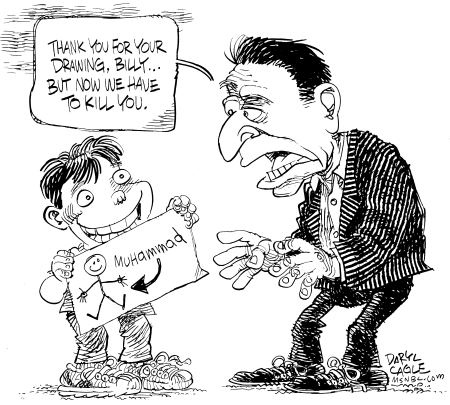
To Muslims, depictions of people – and especially depictions of Muhammad – are forbidden, so it doesn’t matter if the cartoons make a statement or not; the very idea that cartoons of Muhammad exist is offensive. To a Western eye, there is little that is offensive in the cartoons. News reports refer to the “Danish cartoons including one showing a bomb in Muhammad’s turban,” and even that is an exaggeration, describing the 12 cartoons by mentioning only the one that Westerners could imagine causing some offense. Truly offensive cartoons, which never appeared in the Danish newspaper, have been circulated to Muslim crowds to whip up their angry religious fervor.

The overblown reaction in Muslim countries to the blasphemy of the cartoons is what the story has become, as streets filled with violent protestors demand that the infidels in other countries respect a Muslim taboo. Clearly there are many in the Muslim world that are eager to stoke the fires of a clash of civilizations; they think they have found their popular issue with the cartoons.

Politically correct commentators in the West devote equal time to condemning Denmark’s Jylland-Posten newspaper as they do for the crowds that are burning embassies and inciting even more violence. Almost every newspaper in America has refused to reprint the cartoons, leaving readers to believe that if they saw the cartoons, they would be offended too. In fact, if American readers saw the cartoons we would say, “This? This is what makes them so angry? That’s crazy!”

New and truly offensive Muhammad images are popping up all over the Web. The images show a Muhammad toy on a Lego box, having sex with an underage Lego Aysha girl, Muhammad on products such as urinals and toilet paper, and lots of usage of the original Danish cartoons, revamped to make them more offensive with references to sex, pork, drugs and Danish products that are boycotted in Arab countries.

Not to be outdone, a Belgian-Dutch Islamic political organization, the Arab European League (AEL) has started posting cartoons that they think will be as offensive as possible to the Danish. They describe their effort this way:

“After the lectures that Arabs and Muslims received from Europeans on Freedom of Speech and on Tolerance. And after … many European newspapers republished the Danish cartoons on the Prophet Mohammed. AEL decided to enter the cartoon business and to use our right to artistic expression. Just like the newspapers in Europe claim that they only want to defend the freedom of speech and do not desire to stigmatize Muslims, we also do stress that our cartoons are not meant as an offence to anybody and ought not to be taken as a statement against any group, community or historical fact. If it is the time to break Taboos and cross all the red lines, we certainly do not want to stay behind.”

One cartoon on the AEL site has gotten the most attention; it features Holocaust victim Anne Frank in bed with Adolf Hitler, apparently after having sex, Hitler smokes a cigarette and says, “Write this one in your diary, Anne.” Aside from that cartoon, it appears that the cartoons that the AEL thinks will be most offensive to Danes are anti-Semitic and Holocaust denial cartoons that are not different from what passes as everyday fare in Arab newspapers. Of course, for the AEL to make their point effectively, we’ll need to see the Danes respond by marching in the streets, burning embassies, and calling for the executions of AEL cartoonists.

The proper response to an insult in the press is to respond with more speech, rather than violence in the streets, and the escalating war of offensive cartoons is simply speech. But as the reactions become uglier, readers may believe that the truly offensive images they see on the Web are the kind of cartoons that set off this clash of civilizations, rather than the dull, banal Danish cartoons that they haven’t seen. It is important that readers understand what a small spark set off this religious bomb. American editors should rethink their decision not to reprint the original Danish cartoons.

Daryl Cagle is the political cartoonist for MSNBC.com. He is a past president of the National Cartoonists Society and his cartoons are syndicated to over eight hundred newspapers, including the paper you are reading. His book, “The Best Political Cartoons of the Year, 2006 Edition” and “The Big Book of Bush Cartoons” is available in bookstores and Amazon.com now.

Categories
Cartoons

Palestinian Footsie

Palestinian Footsie Color © Daryl Cagle,MSNBC.com,Hamas, Fatah, Abbas, pig, piggie, foot, footsie, toes, palestine, palestinian, Abbas, payoffs, sore loser, election, failed, society, hate-filled, violence, money

Categories
Cartoons

Osama the Dog

Osama the Dog © Daryl Cagle,MSNBC.com,Osama Bin Ladin, Usama Bin Ladin, laden, dog,truce,iraq,afghanistan, war, on fire, terror, terrorism, Middle East, mideast

Categories
Cartoons

King George

King George Color © Daryl Cagle,MSNBC.com,George Walker Bush, King, President, Henry the Eighth, Henry VIII, Britain, King, Holbein

Categories
Columns

Cartoon Jihads

Nothing generates anger in the Muslim world like a cartoon. The most recent cartoon-Jihad comes from a Danish newspaper that printed cartoons depicting the prophet Muhammad. The Jyllands Posten, Denmark’s biggest newspaper, has been bombarded by street protests, international diplomatic incidents and death threats against cartoonists who have gone into hiding, fearing for their lives.

I’m fond of the Jyllands Posten newspaper because they run my cartoons. Reporter Anders Raahauge wrote the report below to cartoonist Doug Marlette who alerted me to the ongoing events:

“To test the limits of self-censorship, we asked all Danish cartoonists to draw Muhammad. We were provoked by the fact that a Danish author of children’s books couldn’t find any illustrators for his planned, decidedly non-polemic book on the prophet. Twelve cartoonists dared.

“There has been a great uproar. 5000 Danish Muslims protested in the streets of Copenhagen, 12 Muslim ambassadors demanded that our Prime Minister should take immediate and harsh action against (us) which he firmly declined (to do). The ambassadors then complained to the “Organization of the Islamic Conference”; there has been a general strike in Kashmir, and a political party in Pakistan, with Danish affiliations, has put a bounty on the heads of the 12 Danish cartoonists: 50,000 Danish Kroners for each execution.”

Danes treasure their press freedoms. The newspaper ran the Muhammad drawings as part of an article about self-censorship in the press, noting that even with a free press defined by law, there are other constraints regarding what can or can’t be published. The Danish prime minister refused to meet with ambassadors from 11 Islamic countries, led by Egypt, who objected to Denmark’s “smear campaign” and demanded punitive action against the newspaper. The ambassadors then announced a general boycott against Denmark. The United Nations weighed in, conveying sympathies to the offended Islamic countries. Last week, in an apparent concession to the angry Muslims, Danish Prime Minister Anders Fogh Rasmussen urged Danes to exercise their rights to free speech without inciting hatred against Muslims. The Danish government had the prime minister’s words translated into Arabic and distributed to Middle Eastern countries in the hope of easing the diplomatic crisis. Jyllands Posten’s editor-in-chief is quoted as saying, “the next step will be giving orders to suppress the newspaper.”

I found the offending cartoons on the web; they are disappointingly dull and it is hard to see how they could make anyone angry. Muslims consider any graphic depiction of Muhammad to be taboo. For the Muslim countries, it is a matter of imposing their sensibilities upon the infidels in the West. For the Danish “infidels” at Jyllands Posten, it is a matter of press freedom and an unwillingness to accept restrictions on an absolute and treasured freedom, which includes the right to offend anyone they choose to offend. In America we take our freedom to offend seriously; we would never threaten the lives of artists who paint the Virgin Mary with animal dung, or put a crucifix into a jar of urine -we limit the argument to whether our National Endowment for the Arts will subsidize these artists.

Depictions of Muhammad are not the only cartoons that inspire Islamic rage. Montreal Gazette cartoonist Terry “Aislin” Mosher had a similar experience. In response to a deadly terrorist attack against foreign tourists in Luxor, Egypt, Mosher drew a dog wearing Arab headgear; the dog was labeled “Islamic Extremism” and the caption read, “With Apologies to Dogs Everywhere.” Mosher and his newspaper received a flood of Muslim threats and vitriol in a Jihad similar to the situation in Denmark.

A cartoonist whom I syndicate, Sandy Huffaker, drew a cartoon showing an Iraqi holding a book titled, “The Koran for Dummies,” and an American soldier asks, “Anything in there about GRATITUDE?” I was bombarded by many thousands of e-mails in a flame campaign instigated by the Council on American Islamic Relations (CAIR), which asked readers on their Web site to e-mail me. The e-mails were hysterical, filled with colorful threats and demands that I fire and punish Huffaker. I posted a big batch of the emails on my Web site and asked my own readers to respond to CAIR. (My Web site has a rather large audience, so I flamed CAIR back.) Being on the other end of a flame campaign may have been a new experience for CAIR, because their flame campaign against me stopped abruptly -or more likely, CAIR saw that the hysterical rantings of their supporters, displayed on my Web site, did not speak well for their cause.

Pulitzer Prize-winning cartoonist Doug Marlette of the Tallahassee Democrat, found himself blasted by a CAIR e-mail Jihad when he drew a cartoon with the caption, “What Would Muhammad Drive?” The drawing showed a man wearing Arab headdress and driving a Ryder truck (a reference to Oklahoma City bomber, Timothy McVeigh). In response to an inquiry from Jyllands Posten, Doug writes, “I was used to negative reactions from religious interest groups, but not the kind of sustained violent intensity of the Islamic threats. The nihilism and culture of death of a religion that sanctions suicide bombers, and issues fatwas on people who draw funny pictures, is certainly of a different order and fanatical magnitude than the protests of our home-grown religious true believers.”

Marlette continues, “As a child of the segregated South, I am quite familiar with the damage done to the “good religious people” of my region when the Ku Klux Klan acted in our name. The CAIR organization that led the assault (on me), describes itself as a civil rights advocacy group. Among those whose “civil rights” they advocated were the convicted bombers of the World Trade Center in 1993. They cannot be taken seriously. For many of those who protested my cartoon, recent émigrés, many highly educated, it was obvious that there was not that healthy tradition of free inquiry, humor and irreverence in their background that we have in the west. There was no Jefferson, Madison, Adams in their intellectual tradition. Those who have attacked my work, whether on the right, the left, Republican or Democrat, conservative or liberal, Protestant, Catholic, Jewish or Muslim, all seem to experience comic or satirical irreverence as hostility and hate. When all it is, really, is irreverence. Ink on paper is only a thought, an idea. Such people fear ideas. Those who mistake themselves for the God they claim to worship tend to mistake irreverence for blasphemy.”

Muslim countries expect the press in Denmark to suppress cartoons that would be offensive to them, but they don’t extend the same cartoon courtesy to others that they demand for themselves. Cartoons in the Arab press are typically so ugly and racist that American audiences have never seen anything like them. Middle Eastern cartoon venom is targeted toward Israel, often depicting Jews with hooked noses and orthodox garb, sometimes with fangs and bloody teeth, often in the roles of Nazis. The Jews are sometimes shown crucifying Arabs in a “Jews killed Jesus” scenario, or enacting their own concentration camp Holocausts on their neighbors, along with their henchmen, the Americans. The cartoons are designed to be as offensive to Jews as possible, and are seen as nothing out of the ordinary by Middle Eastern newspaper readers.

Unless we defend our funny little drawings with the same zeal that we see from the victims of our irreverence, we’ll continue to see our freedoms constricted by the loud voices of those we offend.

©2006 Daryl Cagle – Daryl Cagle is a political cartoonist and blogger for MSNBC.com. He is a past president of the National Cartoonists Society and his cartoons are syndicated to more than 800 newspapers, including the paper you are reading. His books “The BIG Book of Bush Cartoons” and “The Best Political Cartoons of the Year, 2006 Edition,” are available in bookstores now.

Categories
Cartoons

New Year 2006

New Year 2006 © Daryl Cagle,MSNBC.com,bush,gun,2005,2006,new year,baby,war,soldier,president

Categories
Cartoons

Santa in Iraq

Santa in Iraq © Daryl Cagle,MSNBC.com,Christmas,xmas,x-mas, terror, Iraq, Salvation Army, charity, bomb, war, suicide bombers,tactics, greed, false god, gifts, knee, praise, Allah, santa

Categories
Cartoons

Brokeback Mountain

Brokeback Mountain © Daryl Cagle,MSNBC.com,gay, homosexual, cowboy, movie, entetainment, making out, playing

Categories
Cartoons

Lost Fortune

Lost Fortune © Daryl Cagle,MSNBC.com,Fortune Teller, Lost, ABC, television, TV, media, entertainment, drama, science fiction, unsatisfying, new episode

Categories
Cartoons

France on Fire

France on Fire © Daryl Cagle,MSNBC.com,wig,17th, century, Marie Antoinette, ballroom, fan, French, France, fire, car, burning

Categories
Cartoons

Republicans and Alito

Republicans and Alito Color © Daryl Cagle,MSNBC.com,linus, peanuts, security blanket, judge, alito, supreme court, elephant, trunk

Categories
Columns

Cartoonists and Cockroaches

A column in Sunday’s Los Angeles Times starts off like this:

“POPE JOHN XXIII, or ‘Good Pope John,’ remains one of the most beloved figures in recent Catholic history. Among treasured memories of this kindly, roly-poly pope, perhaps none looms larger than the evening of Oct. 11, 1962, when he told a vast crowd on a moonlit night in St. Peter’s Square, ‘Go home tonight and give your children a kiss, and tell them that this kiss comes from the pope.’ When German Cardinal Joseph Ratzinger, the Vatican’s stern doctrinal enforcer, was elected as Benedict XVI in April, an editorial cartoon in an Italian paper showed him looking at a similar crowd and saying, ‘Go home tonight and give your children a spanking, and tell them that this spanking comes from the pope.’

“In a nutshell, the cartoon captured many people’s expectations of Benedict XVI: a hard-line taskmaster who would bring liberals and dissenters in Roman Catholicism to heel.”

Speakers and columnists, like this one, often quote cartoons but seldom mention the name of the cartoonist. With this writer, one fourth of his column came from an uncredited cartoonist. (I think it is fitting that one fourth of my own column starts off with a quote from a writer whom I have chosen not to name.) Writers are almost always named when they are quoted, but cartoons seem to be mere anecdotes that deserve no attribution beyond, “I saw this cartoon …”

An unnamed op-ed page editor at the Los Angeles Times told me that he doesn’t like political cartoons because they tend to “overpower the words that surround them.” He went on to tell me that his two favorite cartoonists are Tom Toles and Ted Rall, two cartoonists with rudimentary drawing styles who put lots of words into their cartoons; this editor liked these cartoonists because they were “more like writers than artists.”

There seems to be a natural friction between the “picture people” and the “word people” who are troubled by those powerful pictures. A famously unnamed editor at The New York Times is quoted as saying, “We would never hire an editorial cartoonist at the Times, because we would never give so much power to one man.” Another unnamed New York Times editor is quoted as saying, “We don’t like editorial cartoons at the Times because you can’t edit a cartoon like you can edit words.”

Editors see cartoonists as “bomb throwers,” because cartoonists enjoy a different set of journalist ethics than writers. Cartoonists can put any words into the mouth of a public figure, whether those words were actual quotes or not. Cartoons make readers angry. A strong political cartoon generates much more mail from readers than the strongest words. Most editors are timid and want to avoid controversy; they choose to run syndicated cartoons that are unobjectionable gags about current topics. Cartoonists call this “Newsweekification” after the inoffensive, bland and opinionless – but funny – political cartoons that Newsweek magazine chooses to reprint each week, further trivializing political cartoons.

The power and effectiveness of political cartoons cause more and more newspapers to avoid cartoons. There are half as many editorial cartoonist jobs as there were 75 years ago. Of the biggest newspapers in America – The Wall Street Journal, USA Today, The New York Times, the New York Daily News, the Chicago Tribune – none have political cartoonists on staff.

The newspaper industry often complains about a dwindling and aging readership as younger readers prefer to get their news through other media. The old-line “word people” lament that youngsters nowadays get their news from Jon Stewart on “The Daily Show.” In fact, most young people get their news from political cartoons. Every state in the United States has middle and high school students interpret an editorial cartoon as part of state-mandated testing. Teachers who must “teach to the test” include political cartoons in their classes. Students learn their current events through political cartoons and, ironically, most of the students see newspaper political cartoons on the Internet rather than on paper (visit www.cagle.com). The “word people” who run newspapers have “Newspapers In Education” programs to try to develop a younger readership, but when a stack of newspapers is dropped on a teacher’s doorstep once a week, there is usually only one political cartoon on the editorial page – not very useful to a teacher who only needs the newspaper to teach about editorial cartoons.

Perhaps in the future we’ll see this turn around, and see more columns like this one, where cartoonists’ names are mentioned and writers’ names are not; when that happens, I expect traditional newspapers will have long gone extinct. Just as the cockroach will continue to roam the Earth long after mankind has disappeared, political cartoonists will still be crawling out from dark corners long after the “word people” have killed off newspapers.

Daryl Cagle is a political cartoonist and blogger for MSNBC.com. He is a past president of the National Cartoonists Society and his cartoons are syndicated to more than 800 newspapers, including the paper you are reading. His books “The BIG Book of Bush Cartoons” and “The Best Political Cartoons of the Year, 2005 Edition,” are available in bookstores now.