Categories
Columns

Column Repost

This column is posted courtesy of my buddy, Dave Astor, at Editor & Publisher.

PULITZER WINNER: Ramirez Hopes His Award Illustrates the Need for ‘Substantive’ Cartoons

By Dave Astor

Published: April 07, 2008 5:05 PM ET

NEW YORK Last year, the buzzword in the Pulitzer Prize editorial cartooning category was “animation.” This year, winner Michael Ramirez hopes the buzzword is “substantive.”

“My approach is to have a powerful image along with a significant statement,” said the Investor’s Business Daily (IBD) cartoonist, when reached by phone this afternoon. “It’s great to be funny, too, but the most important element is the message — to have an impact and make people think.”

Ramirez added: “Editorial cartooning is an extension of journalism, not just entertainment.”

Some editorial cartoonists — whether on their own volition or because of pressure from controversy-averse papers — rely a lot on gags these days.

Ramirez, who now has two Pulitzers, said cartoonists trying to make substantive statements “have to do their homework.” He’s helped in this respect by being part of the team running the IBD editorial page — a level of responsibility few other staff cartoonists have at their newspapers.

“It gives me a better perspective on the news,” he explained.

Ramirez, 46, joined IBD in early 2006 — soon after being forced out of the Los Angeles Times. When asked if winning the Pulitzer was especially satisfying after that experience, he took the high road.

“I’m very grateful for the time I spent at the Times,” Ramirez said. “There were some wonderful people there. They gave me a great deal of creative freedom, and were very supportive until the last one-and-a-half years. I’m sad I wasn’t able to win a Pulitzer for them.”

But Ramirez said he’s thrilled to win for his current paper. “It’s fantastic to bring one home for IBD,” he said.

Ramirez previously won the Pulitzer in 1994 for The Commercial Appeal of Memphis, for which he worked from 1990 until joining the Times in 1997.

Cartoons in Ramirez’s Pulitzer portfolio this year included ones that commented on the vagueness of some of Barack Obama’s stands, on the troubled U.S. economy, on the use of corn to make ethanol rather than as food, and on other topics. Ramirez is considered a conservative cartoonist, but said he tries to approach every issue with an open mind. Sometimes, he noted, conservatives criticize his work.

Last year, all three cartoon finalists did some animation in addition to print work, and observers wondered if this was the shape of things to come for the Pulitzer. But Ramirez doesn’t do animation.

The California resident did say he likes some of the animation out there, and may try it himself at some point. But Ramirez reiterated that the most important thing about a cartoon is the message — whether it’s conveyed in a black-and-white print cartoon, in a color print cartoon, or in an animation.

Ramirez’s work is syndicated by Copley News Service.

When reached by E&P, Copley Vice President/Editor Glenda Winders said: “We are thrilled and so proud of Michael. He is the master of integrating art and idea, and he richly deserves this second Pulitzer. It’s a happy day here at CNS!”

Dave Astor ([email protected]) is a senior editor at E&P.

Categories
Columns

Cagle’s New Newsletter Top Ten

Visit our newsletter sign-up page and subscribe to your favorite cartoonists and columnists. We’ve had free e-mail newsletters for a few months now, we’re seeing some new trends in subscriptions and I thought I would post a new “Top Ten” list now that we have a much bigger list of subscribers. My own name in the top spot is an aberration, because this is my own site and I’m probably the most recognizable name on the list.

1. Daryl Cagle

2. Eric Allie

3. Pat Bagley

4. Brian Fairrington

5. Monte Wolverton

6. Andy Singer

7. Matt Bors

8. Shannon Wheeler

9. Chuck Asay

10. Kirk Anderson

The most interesting change is Kirk Anderson’s climb to number 10 on the list – since Kirk hasn’t submitted a new cartoon for four months! Maybe this just shows that Kirk has fans who are frustrated by his hiatus. I e-mailed Kirk and asked him what’s happening with his ‘toon drought”, and he tells me he will be drawing more and wants to keep his stale slot on the site, so I share the frustration of our readers. That Kirk can gather hundreds of new subscribers while he draws no new cartoons is truly amazing.

The other newcomer to the newsletter top ten is Christian-conservative cartoonist Chuck Asay, who draws in a multi-panel format. I remain impressed with the popularity of altie cartoonists Matt Bors, Shannon Wheeler and Andy Singer. Jen Sorensen was on our top ten list last November, and she dropped to number 11. Lloyd Dangle is number 13. These are alternative cartoonists who don’t get a lot of ink in mainstream, daily newspapers and it is instructive to me to see their popularity on our site over many of the stars of traditional editorial cartooning.

Categories
Columns

Fine-tooning the Planet

My buddy, Steve Greenberg has a new book out. called Fine-Tooning the Problem, available here from his web site. I asked Steve to send me a cartoon that caused him some trouble, and that’s his trouble making cartoon below, along with Steve’s comments. See Steve’s online archive here. E-mail Steve.

I definitely get grief when I do cartoons sympathetic to Israel, like the recent one about the endless rocket attacks on the town of Sderot, near the Gaza border. I got snarling diatribes about “U.S. sponsored terrorism” and massacres of civilians and even a brutal Arab cartoon of an Israeli soldier mowing down bottle-fed tots who were merely throwing paper airplanes. But those aren’t paper airplanes being hurled at Israel, they are rockets, and although crude, have killed and injured many people, destroyed buildings, and left civilian populations living in fear at all moments.

Hamas supporters are shooting 50 to 100 or more rockets at Israeli civilians, aiming indiscriminately, and doing so every day. The Israeli response has been to try to take out the attackers, which is a far cry from Hamas specifically targeting civilians, but the rocket launchers are deliberately mixed among civilian structures in Gaza. For Hamas, a non-response from Israel is a win, but a response that kills bystanders and generates sympathy is a win too.

I’ve done cartoons critical of Israel, which sometimes draws mild rebukes from Jewish readers. But do a cartoon sympathetic to Israel nowadays, and screaming vitiol and sometimes blatantly anti-Semitic remarks start coming in. The only comparable responses are from cartoons relating to abortion. –Steve Greenberg

Categories
Columns

Dodging Sniper Bullets…

The columnists and cartoonists have been focusing on Hillary Clinton’s goofy claims to have dodged sniper fire on a visit to Bosnia with her daughter, Chelsea and comedian, Sinbad.

As he often does, comedian Bill Maher stole from the week’s political cartoons for his monologue, including the Bagley cartoon at the right, for his joke about Hillary claiming to raise the flag at Iwo Jima. See our Hillary Under Fire collection here.

Here are some interesting columns on Hillary’s travels and bullet dodging experience, by Michael Reagan, Leonard Pitts and Michelle Malkin. Bill Maher railed about this interesting Pat Buchanan column on his weekly show. Visit our sites each week and you can write a TV show just like Bill Maher!

Categories
Columns

YAHTZEE FEST

I used to be more assertive about posting “Yahtzees” (my term for when five or more cartoonists draw matching cartoons). Some of the most Yahtzee-prone cartoonists got their noses out of joint by my pointing out their similaries, and they chose to leave the site. I’m a bit less motivated to rub the noses of our loyal contributors in their similar cartoons now that some of the worst offenders escape criticism by bailing out. That said, our readers love the Yahtzees, and I get e-mails asking whether I’ve noticed this Yahtzee or that Yahtzee – and why don’t I post them?! OK, I won’t post them all, but here are some representatives from three big, recent Yahtzees.

Olympics Logo Yahtzee

The Olympics logo as the wheels on a tank is a mega-Yahtzee that we see each time the Olympics come around, particularly among the international cartoonists who prefer cartoons without words and who like to use logos and flags to complain about militarism. I must have seen a couple of dozen of these logo-tank cartoons, here are some recent ones from Julius Hansen (Denmark), Martin Sutovek (Slovakia) and Frederick Deligne (France). I’ve included three oldies from Dick Wright, Bob Gorrell and Patrick Chappatte.

Faucet and Pills Yahtzee

We got a lot of pills coming out of the water faucet in response to the news that traces of drugs were found in municipal water supplies. These are from John Sherffius, Gordon Campbell, Robert Ariail and Nate Beeler.


Castro Cigar Yahtzee

Here are a few from the Castro Cigar Mega-Yahtzee. These are from Michael Ramirez, John Deering, Gary Brookins, Arcadio Esquivel (Costa Rica) and Christo Komarnitski (Bulgaria).

That’s all for now.

Categories
Columns

Welcome Gordon Campbell

Today we’re adding cartoonist Gordon Campbell to our site. This is ironic, because Gordon is the latest casualty in the parade of cartoonist job layoffs. Even without a job (at the Inland Valley Daily Bulletin), Gordon will continue to draw cartoons regularly as a freelancer – a fate that seems to be in the future for every cartoonist. See Gordon’s cartoon archive. E-mail Gordon. I asked Gordon to tell us a bit about his situation.

And the year started out so promising, too! For over six months a full-blown, knock-down, drag-out political war has been going on over who would be every editorial cartoonist’s favorite target over the next four years. Maybe I was energized by the smell of metaphorical cordite and sulfur, but I’ll be damned if my cartoons weren’t getting better and better as the conflict raged. But, like the theme in Les Miserables, there was an ominous soundtrack playing in the background, increasing in volume, that I was desperate not to hear! This tune, signaling the post-journalistic revolution, was accompanied by another, grating rasp like the sound of hardwood rolling on cobble. The guillotine was wheeling into the newsroom!

Our paper had gone through a lot of down-sizing, right-sizing, cut-backs, re-organizations, re-tooling, ill-conceived projects that begat other ill-conceived projects etc. over the past few years and of course the whole “dead tree biz has been in the gravity of the black hole of “Alternative Media Sources for sometime. On top of all that, Media News had bit off a whole lot more than it could chew when they picked up the northern Cal properties just before the property bubblewell, you all know the tune. Every paper in America has a similar sad song to sing these days.

To “burrow myself in,” so to speak, in 2003 I had begun offering my work to the other papers in the chain por nada. As company papers in our area were functionally merged, my work appeared in all those papers every day as well. I was also the highest “hit man in the on-line editions, a top priority endeavor according to management, so I felt somewhat safe. A week before my papers executions the Daily News of Los Angeles had a similar layoff and cartoonist Patrick O,Connor survived that round. Surely, I thought, I’m in no immediate danger. Ha!

So now I’m free. All my toonist buddies tell me so. They say I just have to see this as an opportunity to soar above the turkeys and fly up to the highest peaks of graphic commentary. I know I should feel liberated but it still seems like part of me is rolling around in a basket on Bastille Day!

Gordon Campbell

Categories
Columns

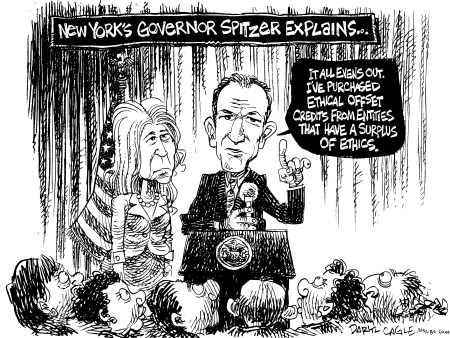
The Seven Deadly Offset Credits

The Vatican just announced a brand new, modern set of seven deadly sins to supplant the old seven sins which have grown pretty tired through the years. The old seven deadly sins: lust, wrath, gluttony, sloth, greed, pride, and envy were proclaimed by a sixth century pope and were made famous by Dante in his “Divine Comedy” and by Brad Pitt and Morgan Freeman in the movie “Seven,” which was a pretty darn scary movie.

The new sins are:

1. Genetic engineering

2. Drug abuse

3. The disparity between the very rich and the very poor

4. Pollution

5. Abortion

6. Pedophilia

7. Causing social injustice

The church describes the new sins as social in nature and “a corollary of the unstoppable process of globalization.” Societies have experience regulating social issues, like pollution, and that experience gives us a great leg up on regulating the other sins.

California’s Governor Schwarzenegger likes to fly his jet home, from Sacramento to Los Angeles, each night after work, so he can spend time with his family. Schwarzenegger creates a lot of pollution in his daily commute, but the governor buys carbon-offset credits from businesses that are more environmentally friendly than they need to be, selling their eco-surplus back to the governor. Al Gore does the same thing, reducing his big carbon footprint from his private flights and his big houses by buying carbon-offset credits. It’s cool. Offsets work. It’s the free-market solution and the system works for other sins too.

“The disparity between the very rich and the very poor” is another great sin for offset credits. Very poor people could sell their “poor-people-offset credits” to very rich people who need to relieve their guilt about being rich and reduce the size of their very rich footprint. “Poor-people-offset credits” would create a free market of guilt-reduction exchanged for income redistribution that would work every bit as well as the carbon-offset credits work to reduce the guilt of polluters.

In fact, the system applies to all of the deadly sins. This afternoon I watched New York Governor Eliot Spitzer squirm, under the glare of his dowdy wife, at a one-minute press conference about his being caught as the customer of a high-priced hooker. I’ve never used the services of a prostitute myself, and I think I deserve some credit for that – credits that I should be able to sell to Governor Spitzer at a time when he really needs the “hooker-offsets.”

In fact, I personally fare much better with this new set of seven deadly sins than I did with the first set. As an editorial cartoonist, I create very little pollution – I even use those curly light bulbs. Given the number of pencils I use, I probably haven’t killed any more than one tree in my whole career. Two at the most. Not counting the paper.

I don’t cause social injustice (not much anyway); I’m not a pedophile; I don’t have abortions; I don’t abuse drugs or do any genetic engineering. I score so well on the new sins test that I should be awarded plenty of offsets that I could sell back to the Vatican to offset their pedophile priest problem.

I’ll be rich! (But not “very rich,” because that would be a sin.)

Daryl Cagle is a political cartoonist and blogger for MSNBC.com. Daryl is a past president of the National Cartoonists Society and his cartoons are syndicated to more than 800 newspapers, including the paper you are reading. He runs the most popular cartoon site on the Web at www.cagle.msnbc.com. His books “The BIG Book of Bush Cartoons” and “The Best Political Cartoons of the Year, 2005, 2006, 2007 and 2008 Editions,” are available in bookstores now.

Categories
Columns

The Seven Deadly Offset Credits

The Vatican just announced a brand new, modern set of seven deadly sins to supplant the old seven sins which have grown pretty tired through the years. The old seven deadly sins: lust, wrath, gluttony, sloth, greed, pride, and envy were proclaimed by a sixth century pope and were made famous by Dante in his “Divine Comedy” and by Brad Pitt and Morgan Freeman in the movie “Seven,” which was a pretty darn scary movie.

The new sins are:

1. Genetic engineering

2. Drug abuse

3. The disparity between the very rich and the very poor

4. Pollution

5. Abortion

6. Pedophilia

7. Causing social injustice

The church describes the new sins as social in nature and “a corollary of the unstoppable process of globalization.” Societies have experience regulating social issues, like pollution, and that experience gives us a great leg up on regulating the other sins.

California’s Governor Schwarzenegger likes to fly his jet home, from Sacramento to Los Angeles, each night after work, so he can spend time with his family. Schwarzenegger creates a lot of pollution in his daily commute, but the governor buys carbon-offset credits from businesses that are more environmentally friendly than they need to be, selling their eco-surplus back to the governor. Al Gore does the same thing, reducing his big carbon footprint from his private flights and his big houses by buying carbon-offset credits. It’s cool. Offsets work. It’s the free-market solution and the system works for other sins too.

“The disparity between the very rich and the very poor” is another great sin for offset credits. Very poor people could sell their “poor-people-offset credits” to very rich people who need to relieve their guilt about being rich and reduce the size of their very rich footprint. “Poor-people-offset credits” would create a free market of guilt-reduction exchanged for income redistribution that would work every bit as well as the carbon-offset credits work to reduce the guilt of polluters.

In fact, the system applies to all of the deadly sins. This afternoon I watched New York Governor Eliot Spitzer squirm, under the glare of his dowdy wife, at a one-minute press conference about his being caught as the customer of a high-priced hooker. I’ve never used the services of a prostitute myself, and I think I deserve some credit for that ­ credits that I should be able to sell to Governor Spitzer at a time when he really needs the “hooker-offsets.”

In fact, I personally fare much better with this new set of seven deadly sins than I did with the first set. As an editorial cartoonist, I create very little pollution ­ I even use those curly light bulbs. Given the number of pencils I use, I probably haven’t killed any more than one tree in my whole career. Two at the most. Not counting the paper.

I don’t cause social injustice (not much anyway); I’m not a pedophile; I don’t have abortions; I don’t abuse drugs or do any genetic engineering. I score so well on the new sins test that I should be awarded plenty of offsets that I could sell back to the Vatican to offset their pedophile priest problem.

I’ll be rich! (But not “very rich,” because that would be a sin.)

Categories
Columns

Ette Hulme

I thought I’d take some time out to highlight Etta Hulme, a cartoonist who should get more attention here. Click on the image at the right to watch an interview with Emma. She’s the most widely read woman cartoonist in America, with hundreds of newspapers running her syndicated cartoons. Etta is a charming, talented, grandmotherly character and her cartoons are just as warm and charming – in sharp contrast to the harsh, younger cartoonists.

Thanks to Dr. Elaine K. Miller, a college professor who specializes in the study of editorial cartoons and who produced the documentary on Etta that the clip is taken from. I hope to see it on TV! E-mail Dr. Miller. See Etta’s cartoon archive. See the Etta interview clip.

Visit Etta Hulme’s cartoons.

Categories
Columns

Thin-Skinned Editorial Cartoonists

Our readers never miss an opportunity to let me know when my productivity drops off. I had the flu last week and I haven’t been writing and drawing as much as I should. A few days ago, as I was recovering from my viral stupor, the editorial cartoonist community was agitated into an online kafuffle by an anonymous critic on the web. I was surprised by the overblown reaction from my peers, who posted to chat boards, e-mailed me and e-mailed each other in a thin-skinned conniption fit.

The anonymous guy ranted mostly about cartoons that he thought were lousy, but he saved some of his venom for me. He doesn’t like my web site which he thinks looks like “vomitus.” He was also bothered by the ads on my site, complaining that I’m greedy, cheap and fat. The guy showed particular interest in my “fat ass.”

All in all, the anonymous “Bad Cartoonist” sounds like most of my daily e-mail. My cartooning colleagues need to understand that the internet is built upon a foundation of rude, anonymous jerks and get back to their job of being graphically rude on the editorial pages.


Cuban Cartoon Debate

A couple of weeks ago I posted Cuban cartoonist Ares‘ take on the change in Cuba as Fidel Castro turned the presidency over to his brother, Raul Castro (left). Cuban ex-patriot cartoonists Alen Lauzan, from Argentina, and Osmani Simanca from Brazil, drew a cartoon rebuttal to Ares’ cartoon (right) and I thought it was fun, so I post it here. Click on the cartoon to see an enlarged version, and you’ll see that they “flopped” Ares’ signature.

Cartoonists don’t often carry on cartoon arguments with each other ­ when they do, I point it out!

Check out our Fidel Quits cartoons.

Categories
Columns

How to Draw Hillary

As a cartoon character, Hillary is definitely the best choice for president and her dive in the polls has some editorial cartoonists sweating. She’s barely holding on after her win tonight in Ohio, I haven’t heard the results in Texas, and I’m one of the cartoonists who’s sweating.

As an editorial cartoonist I don’t make up my own characters; the world provides me with characters. Great characters. Better characters than I could ever make up. I sit around at my desk all day, watching Fox News and MSNBC. I get angry and I think of cartoons. It’s the good life.
Compared to a comic strip cartoonist, I’ve got it easy. Comic strip artists spend their whole careers developing characters in tiny, daily increments. It takes years and years of strips before readers know just what is in Lucy’s mind when she holds the football for Charlie Brown – that kind of intimate knowledge of character gives cartoons wonderful depth. When our readers know our characters, we can draw cartoons that are rewarding just because we see the character acting as we already know he will. A subtle bit of body language can be a punch line when readers really know the characters, and it is the best kind of humor when the gag was years in the making.

Hillary Clinton is a cartoon character that has taken many years to develop and every editorial cartoonist can claim her as his own. We know Bill Clinton as intimately as we know Charlie Brown. We know Hillary as intimately as we know Lucy. They are an editorial cartoonist’s treasure.

I drew a cartoon with Bill and Hillary that was probably my most reprinted, most popular cartoon ever. They were on a book tour, and I drew Bill and Hillary at a table together, signing books. Bill had his book open with a Playboy style fold-out dropping out of the book, and Hillary whacked Bill on the side of his head her book. There were no words, just facial expressions and body language. My readers loved it! Oh! The mail I got on that one!

As Hillary’s campaign prospects fade I’m seeing my best characters fade away. Obama is easy to draw, but there’s nothing behind the long face ­ no pain we all shared, no national embarrassment, no anger, no crazy, complex, cheating spouse. For all the excitement of his supporters, Obama is dull. He’s a straight man, commenting on the events around him, or riding the crest of a wave, or driving a steamroller over Hillary. There isn’t any facial expression I can put on Obama that will make the readers say, “I know just what he’s thinking!” The guy is a cartoon disaster.

John McCain isn’t much better. The term of art for McCain is “pudding-face.” In fact, McCain is more like tapioca, with a lumpy face that looks like he has his cheeks filled with marbles; that doesn’t help me much. McCain has a reputation for a hot temper, which is fun for a cartoonist, but we haven’t seen enough of his temper to expect it in a cartoon. Al Gore and John Kerry were stiff, dull and just as bad for cartoonists.

When President Bush ran against Sen. Kerry in 2004, there was no doubt that the best choice for the cartooning business was Bush. In the past eight years we’ve had great material for cartoons. We’ve had wars, terrorist attacks and some ugly times in Washington, but there have been some great cartoons during the Bush administration. Tough times make for good cartoons too. In fact, I’ll bet my cartoons would look better if I knocked my head against the wall a few times. I’ll try that when Hillary drops out of the race.

Categories
Columns

How to Draw Hillary

As a cartoon character, Hillary is definitely the best choice for president and her dive in the polls has some editorial cartoonists sweating.

As an editorial cartoonist I don’t make up my own characters; the world provides me with characters. Great characters. Better characters than I could ever make up. I sit around at my desk all day, watching Fox News and MSNBC. I get angry and I think of cartoons. It’s the good life.

Compared to a comic strip cartoonist, I’ve got it easy. Comic strip artists spend their whole careers developing characters in tiny, daily increments. It takes years and years of strips before readers know just what is in Lucy’s mind when she holds the football for Charlie Brown – that kind of intimate knowledge of character gives cartoons wonderful depth. When our readers know our characters, we can draw cartoons that are rewarding just because we see the character acting as we already know he will. A subtle bit of body language can be a punch line when readers really know the characters, and it is the best kind of humor when the gag was years in the making.

Hillary Clinton is a cartoon character that has taken many years to develop and every editorial cartoonist can claim her as his own. We know Bill Clinton as intimately as we know Charlie Brown. We know Hillary as intimately as we know Lucy. They are an editorial cartoonist’s treasure.

I drew a cartoon with Bill and Hillary that was probably my most reprinted, most popular cartoon ever. They were on a book tour, and I drew Bill and Hillary at a table together, signing books. Bill had his book open with a Playboy style fold-out dropping out of the book, and Hillary whacked Bill on the side of his head her book. There were no words, just facial expressions and body language. My readers loved it! Oh! The mail I got on that one!

As Hillary’s campaign prospects fade I’m seeing my best characters fade away. Obama is easy to draw, but there’s nothing behind the long face – no pain we all shared, no national embarrassment, no anger, no crazy, complex, cheating spouse. For all the excitement of his supporters, Obama is dull. He’s a straight man, commenting on the events around him, or riding the crest of a wave, or driving a steamroller over Hillary. There isn’t any facial expression I can put on Obama that will make the readers say, “I know just what he’s thinking!” The guy is a cartoon disaster.

John McCain isn’t much better. The term of art for McCain is “pudding-face.” In fact, McCain is more like tapioca, with a lumpy face that looks like he has his cheeks filled with marbles; that doesn’t help me much. McCain has a reputation for a hot temper, which is fun for a cartoonist, but we haven’t seen enough of his temper to expect it in a cartoon. Al Gore and John Kerry were stiff, dull and just as bad for cartoonists.

When President Bush ran against Sen. Kerry in 2004, there was no doubt that the best choice for the cartooning business was Bush. In the past eight years we’ve had great material for cartoons. We’ve had wars, terrorist attacks and some ugly times in Washington, but there have been some great cartoons during the Bush administration. Tough times make for good cartoons too. In fact, I’ll bet my cartoons would look better if I knocked my head against the wall a few times. I’ll try that when Hillary drops out of the race.

Daryl Cagle is a political cartoonist and blogger for MSNBC.com. Daryl is a past president of the National Cartoonists Society and his cartoons are syndicated to more than 800 newspapers, including the paper you are reading. He runs the most popular cartoon site on the Web at www.cagle.msnbc.com. His books “The BIG Book of Bush Cartoons” and “The Best Political Cartoons of the Year, 2005, 2006, 2007 and 2008 Editions,” are available in bookstores now.