I’m now in Harbin, in Northern China, as part of a US State Department cultural exchange program that introduces Chinese audiences speakers from the USA. They have never had an American cartoonist participate in the program before; I’m the first one, and I seem to be a provocative choice for the Chinese students.
The consulate in Shanghai requested an American editorial cartoonist (and I’m an easy cartoonist to find). I’m meeting with Chinese cartoonists, speaking to university students and seeing the sights. The Chinese don’t see American editorial cartoons in their newspapers, we don’t see Chinese editorial cartoons in our newspapers and there is a wide cultural divide when it comes to journalism. The students seem to be amazed at the very idea that cartoonists would dare to be disrespectful of their government leaders.
I explain to the classes about “censorship” in America, and that the government never censors cartoonists, but that freedom of the press belongs to the guy who owns the press and cartoonists often complain about their editors. I tell them about the AAEC’s Golden Spike Award and show them examples of killed cartoons. They seem to be especially interested in this topic.
I leave a lot of time for questions and answers with each group I talk to; they can be shy, but when they get started they have lots of questions, and I get the same questions wherever I go. Here are some examples of recurring questions and answers:
Do your cartoons hurt your personal relationships with the politicians you draw?
No, I don’t have personal relationships with the people I draw.
Do you worry that your drawings will hurt the reputation of someone you have drawn?
No, if one of my cartoons hurts the reputation of a politician that I am criticizing, then I am pleased. (Sometimes the crowd murmurs when I say this. It doesn’t seem to be what they expect me to say.)
Do you ever apologize for your cartoons?
Sometimes, but only if I make an error or if the cartoon is misunderstood. Usually the people who are angry about a cartoon are the people I intend to make angry, and I am happy to make them angry. (The crowd murmurs at this answer, too.)
Do you ever draw cartoons that are supportive of China?
No, I don’t draw cartoons that support anything. I just criticize. Supportive cartoons are lousy cartoons.
Now that you have visited China, and have learned more about China, will you be drawing cartoons that support China?
Probably not.
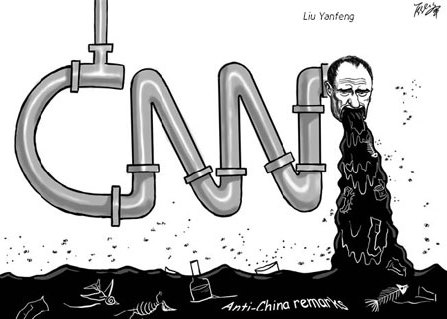
What do you think about the terrible things that Jack Cafferty from CNN said about China? What can be done to make CNN apologize for these remarks?
(I try to be polite here.) Most Americans don’t know Jack Cafferty and haven’t read about his remarks, but most Americans have a negative view of China and would probably agree with Jack Cafferty’s remarks. I wouldn’t expect CNN to apologize. (The students murmur.) It is interesting that Jack Cafferty is a big issue here; the students all seem to know about the guy and seem personally insulted by him. Here’s a Chinese cartoon on Jack Cafferty.
At every event there is a student with a big smile who asks: Do you see many editorial cartoons in the USA about the Olympics? What are the cartoons like?
(I try again to be polite.) Yes there are lots of cartoons about the Olympics, and the cartoons from around the world are almost all negative about China.
The State Department people asked me not to show cartoons about China, thinking that the cartoons would be so provocative that their contacts at the universities wouldn’t want to work with the US speakers program any more, after a cartoon trauma. The students are eager to see cartoons about China. One student said, “You can show us the cartoons about China, really! We’re strong!” I refer the students to my web site to see the cartoons about China, and I tell them what the cartoons are like.
The request to refrain from showing cartoons about China is something I had to contemplate, because I like to say whatever I want. It was the only request the State Department people made of me, regarding what I would have to say and show in China. I decided I was OK with it.
Now that I have heard from the students, and I can see what a huge cultural divide there is, I think I agree that I make important points by just showing how I draw disrespectful cartoons about American leaders. That is enough to shock these audiences and show how different our attitudes are.
The students think that China is misunderstood around the world. They are proud of China, they are all personally very nice, and genuinely expect that the world should love China. At a couple of events students have asked me to list reasons why Americans would not like China; I give them a list of issues and they seem shocked. I think they are not shocked so much by the list of issues as by how this American cartoonist can so misunderstand China.
A person from a US consulate here told me a story about one bright young English student who was working for the consulate. He seemed inspired, was interested in everything and he seemed to be well on the road to understanding what America is all about. One day the English student was at a hotel and he watched CNN’s coverage of China; he had never seen CNN before. The student was so shocked by what he heard on CNN that he came back to his US Consulate friends and told them that he was inspired by watching the news on CNN, and he had decided that he wanted to work for the Chinese government as a censor, to insure that other Chinese people would never have to hear the terrible things he heard on CNN.
The barriers may be so wide that there may be no bridging the gap.
But I shouldn’t be too negative. I’d like to have seen president Bush handle hurricane Katrina like the Chinese are handling the earthquake here.
The Chinese college classes are all very interested, and happy for me to be there. They are eager for me to do drawings and sometimes they rush out and want a photo with me. That’s a gregarious college class that I spoke to in the southern city of Guangzhou in the photo below.


 This is an example of a banner expressing concern and well wishes for the victims of the earthquake. People write their sympathies on the little yellow ribbons and hang them with the banner.


 When American cartoonists look around the world at other cartoonists, we see strange cartoons and an even stranger business. While American cartoonists are most concerned about building a list of publications that print our cartoons, in much of the world cartoonists are motivated to build their CV’s (or resumes) by entering contests. For foreign cartoonists who live in countries where it is impossible to make a living selling cartoons for publication, it makes perfect sense to make a living doing something else while chalking up cartooning successes in contests.
  One of the biggest contests, the World Press Cartoon (WPC) contest in Portugal, has been making a special effort to get American cartoonists to submit entries. They have three categories: gag, caricature and editorial cartoons, each with a 5,000 Euro prize. One of the three category winners brings home the grand prize, a whopping 20,000 Euros (or $31,400.00). WPC just announced their winners for this year which fall squarely into the “strange” and “incomprehensible” category.
  OK. I don’t see a threatening clown, but maybe they mean “cloud.” Nothing was really on fire. That’s not smoke. It’s a cloud. I’m good. Big European bureaucracy. Too many desks. Dark cloud. It’s an allusion to a painting I don’t know. I get it now.
 The National Cartoonists Society Foundation (NCSF) announced the winner of the first annual Jay Kennedy Memorial Scholarship, Juana Medina, a sophomore at the Rhode Island School of Design (RISD). She was chosen by a jury of ten of the nation’s top cartoonists, including Michael Ramirez, this year’s Pulitzer Prize winning cartoonist, Rick Kirkman who draws “Baby Blues,” Mad Magazine’s Tom Richmond, greeting card artist Sandra Boynton and other ‘toon luminaries. I’m the president of the NCSF, and I have to say that is fun giving out scholarships.