


Spring Break TSA Nightmare: Top Ten Cartoons of the Week

 DarylCagle.com

Every day I read something from journalists obsessing about the future of print. The internet is gobbling up newspaper readers and advertisers. The future looks bleak for ink on paper as newspapers respond by downsizing, degrading their product and hastening their own demise. There seems to be a generally accepted axiom that the internet is the future for journalism. Columnists are transforming into multimedia bloggers and cartoonists feel pressure to animate their political cartoons. It makes perfect sense to chase the shifting audience, but the move to the internet doesn’t make much business sense.
Newspapers are bleeding revenue as the web enjoys a rush from new advertisers. The newspaper “group-think” solution is to move onto the internet to reclaim advertising dollars—but the money on the web is flowing to the search engines (mostly to Google) where topical ads are displayed with search results. Ads accompanying original content on the Web still pay poorly. As a political cartoonist, I run some popular Web sites that get millions of page views per month, but the ad revenue only covers the cost of my servers and bandwidth. Newspapers share this problem as they pour resources into building their Web sites and get very little revenue in return. Many try charging their readers to read archives on their Web sites, a strategy that fails almost every time as most Web surfers simply browse somewhere else where content is free.
Newspapers continue to pin their hopes on their Web sites in the belief that their brands carry goodwill into a new medium, when in fact, newspaper brands have little value on the Web. The three most popular news sites on the Web—Yahoo News, CNN and MSNBC.com—dominate the audience, with other news sites trailing far behind. The reason why is simple, each is attached to a huge audience (Yahoo, AOL and MSN.com) which feeds readers into these sites.
My own cartoon site is associated with MSNBC.com, which gets its traffic from MSN.com, which gets most of its traffic from the famous MSN.com home page, the default home page for PC buyers using the Internet Explorer browser, who don’t bother to change their home page. Yahoo and Google channel their huge search engine audiences into their news sites. The trick to finding a big audience on the Web is to bring your site to the audience, not to expect the audience to find your site.
One of the most popular online newspapers, The Washington Post, understands how the Web audience works. The Post partners with MSN.com and MSNBC.com to bring traffic their way. When The Washington Post Company bought my old employer Slate.com from Microsoft, the negotiations focused on Slate continuing to receive a huge audience flow from promotions on MSN.com. The Post understands the Web where traffic flows like a river – the river has to keep flowing or the lake will dry up.
For many newspaper editors, internet strategy is a fantasy from the movie “Field of Dreams.” “If you build it, they will come.” Good content is nice (Slate has great original content) but securing a continuing audience for that content is more important. Yahoo and Google maintain top news sites with almost no original content. That’s journalism 2.0: circulating content that is created in other media, while paying little or nothing for the content.
Reporters, columnists and editorial cartoonists are suffering from ongoing layoffs in the newspaper industry. The cartooning ranks have been thinned and the cartoonists who still have jobs are often asked to do more work online, such as starting blogs and animating their cartoons for the Web. In 2000, Gregg and Evan Spiridellis (JibJab.com) created some animated political cartoons that became hugely popular on the Web and newspaper editorial cartoonists seemed to agree that, in the future, all political cartoons would be animated. The problem for cartoonists is much the same as the problem for other content creators: there is no market for animated political cartoons when Web sites don’t want to pay for content.
I run a popular Web site and I’m the cartoonist for MSNBC.com, but I still make my living selling cartoons that are printed in ink on paper from traditional clients who actually pay. I often get calls from political cartoonists who are starting to animate their cartoons, asking where they can sell their animations; my answer is, “nowhere.” Even the successful JibJab guys use their political cartoons for publicity and make their living doing animations for commercial clients. The editorial cartoonists seem to be charging ahead in their aimless endeavors, typically creating animated political cartoons on the side, for newspaper employers who pay them nothing extra for the extra hours, creating content that no one wants to buy in syndication.
At this summer’s Association of American Editorial Cartoonists conference, there will be two sponsored programs: “What Do You Mean You’re Not Animating Yet?” and “Blog or Die.”
The aimless charge to the internet extends to the Pulitzer Prizes. This is the second year the Pulitzers accepted entries that were not printed, but were posted on the Web sites of paid circulation, daily print newspapers. The winner and nominees this year were all employees of print newspapers who submitted portfolios of animated Web cartoons that could not be printed in their newspapers–a first for the Pulitzers. The editorial cartoonist community is in a tizzy. Cartoonists want to win prizes and keep their jobs, and according to the Pulitzer jury, the way to do that is to jump on an internet bandwagon that no one is steering.
Daryl Cagle won’t be animating his editorial cartoons anytime soon. He is a political cartoonist and blogger for MSNBC.com. Daryl is a past president of the National Cartoonists Society and his cartoons are syndicated to more than 800 newspapers, including the paper you are reading. He runs the most popular cartoon site on the Web at Cagle.msnbc.com. His books “The BIG Book of Bush Cartoons” and “The Best Political Cartoons of the Year, 2005, 2006 and 2007 Editions,” are available in bookstores now.

When a lunatic killed 32 people at Virginia Tech University earlier this week I knew what to expect from political cartoonists, who don’t react well to tragedy. Some of the cartoons seemed insensitive, as today’s generation of jokesters struggled to respond to a story with no lighter side.
I have some sympathy for the editorial cartoonists who have a daily deadline and must respond to the headline of the day. The first cartoons were predictable: Uncle Sam or the Virginia Tech mascot, with bowed heads and flags or the school pennant at half-mast. There were lots of riffs on the school logo (the letters “VT”), including one depicting the school logo in dead bodies. Some cartoonists launched immediately into gun control cartoons – “how terrible it is that guns are so widely available” and “what a shame it is that none of the victims were toting firearms to protect themselves.”
I run a syndicate that distributes editorial cartoons to newspapers, and our editors were not happy. The day after the tragedy one editor from Georgia wrote: “As a Cagle subscriber, I have to tell you the cartoons sent today about the Virginia Tech shootings showed a deplorable lack of sensitivity and taste. Can’t you find (someone) who isn’t so quick to try to be funny or cute at innocent people’s expense?”
As bad as this week was for cartoonists, it was worse for television. An army of aggressive TV reporters descended on little Blacksburg, Va., asking everyone they could find, “How do you feel?” and “Did you know him?” The television coverage reached new heights of ugliness when NBC released the killer’s “Multimedia Manifesto” and all we could see on cable news was 24 hours of “non-stop nut-case.” It took a day for the wallpaper killer coverage to devolve into finger pointing among the media about whether they were doing the right thing in publicizing the killer’s message.
When I first heard about the massacre, I wrote in my blog that I would not be drawing any cartoons about it. But after only two days the story had matured into something I wanted to draw cartoons about because there was something for me to criticize. I drew two cartoons bashing NBC; one showed the NBC peacock dressed up as the network of gun-brandishing Seung-Hui Cho. I drew another showing two kids dressed like Cho, because “He’s the only guy we see on TV now.” I drew another one generally bashing people who didn’t see that Cho was a psychopath, with Cho painting the giant words “STOP ME” on the ground while two oblivious college professors walk by saying, “How can we know something like this is going to happen?”
Political cartooning is a negative art form. Cartoonists and columnists work best when bashing hypocrites or speaking to issues where opinion is divided. I am fortunate to have no daily deadline. When I don’t want to draw on a subject, I don’t have to; that was a luxury for me with the Virginia Tech story. Unfortunately, the deadlines of the 24-hour news cycle demand that most cartoonists, reporters and commentators chime in right away.
Sometimes it pays to take a step back and hold your breath without writing, drawing or reporting anything for a couple of days – until there is something constructive to say.
Daryl Cagle is a political cartoonist and blogger for MSNBC.com. He is a past president of the National Cartoonists Society and his cartoons are syndicated to more than 800 newspapers, including the paper you are reading. His books “The BIG Book of Bush Cartoons” and “The Best Political Cartoons of the Year, 2005, 2006 and 2007 Editions,” are available in bookstores now.


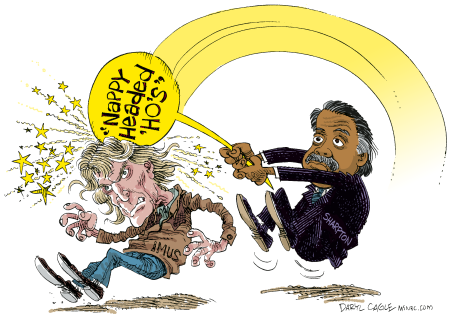
Like most people, cartoonists love to watch stars fall. This was the week to watch Don Imus fall, in a media frenzy that was tailor made for cartoonists. Imus looks like a cartoon character already; his ugly comment, calling the Rutgers women’s basketball team “nappy headed ho’s,” put Imus at the center of a media feeding frenzy, with characters on all sides who wanted to see him bleed.
Many cartoonists pointed out the hypocrisy of crucifying Imus for a comment that was no worse than what we hear in rap music, and no worse than other nasty comments by other, ugly media personalities. Al Sharpton and Jesse Jackson demanded that Imus be fired and used the media frenzy to put their faces in front of television cameras at every opportunity.
In the end, Imus was fired by both MSNBC and CBS, and he no longer has a place on radio or television. I don’t think this week’s Imus rumble will do much to make the media less coarse, and I won’t miss Imus, but I enjoyed the spectacle and it was great fun to draw the guy getting bashed and skewered by his own words.
Daryl Cagle is a political cartoonist and blogger for MSNBC.com. He is a past president of the National Cartoonists Society and his cartoons are syndicated to more than 800 newspapers, including the paper you are reading. His books “The BIG Book of Bush Cartoons” and “The Best Political Cartoons of the Year, 2005, 2006 and 2007 Editions,” are available in bookstores now.
Copyright 2007 Cagle Cartoons Inc. Please contact Sales at [email protected] for reproduction rights.


“24,” 5 1/2 Seasons, One Column (Revised to include the 3/12/07 episode)
With all the news about the military objecting to torture scenes and with cultural references to Jack Bauer everywhere in the media, I realized that it was my duty as a political cartoonist to actually watch “24.” I bought all five seasons as DVD box sets, then I watched the 13 episodes from the current sixth season online; that’s 133 episodes. It took me a month.
I learned four important lessons: 1.) torture works great; 2.) people always give in to the demands of terrorists; 3.) the fate of the world is always decided in the San Fernando Valley; and 4.) it takes me an hour to go anywhere in LA, but federal agents can get anywhere in minutes. Now, while it is still fresh in my mind, here is the story of “24,” all in one column:
We start Season One with Federal Agent Jack Bauer who thinks his boss, George Mason at the Counter Terrorism Unit (CTU), is lying to him, so Jack shoots Mason with a tranquilizer dart. A terrorist parachutes from a plane that she blows up to steal a “key card” that leads to two or three assassination attempts on presidential candidate David Palmer, who has an evil, ambitious, whiny wife Sherry, and who’s being blackmailed because his son murdered a guy who raped his daughter. Jack’s ex-lover, agent Nina, is secretly a CTU mole controlled by an evil Yugoslav family, the Drazens, who are hunting Jack and Palmer for revenge. Jack’s daughter Kim and his pregnant wife Terri are kidnapped and then escape. Jack is blackmailed. Terri gets amnesia. Kim gets into a drug deal and goes to jail with the math professor girlfriend from “Numb3rs.” The evil Drazens break their patriarch, Dennis Hopper, out of a secret jail; they kill Lou Diamond Phillips and kidnap Jack. Kim is kidnapped again and escapes. Jack is blackmailed again; he shoots it out with the Drazens and kills them all. Nina, the evil mole, kills Jack’s wife Terri.
In Season Two, Jack hunts for a nuclear bomb in Los Angeles (Jack says “nu-cu-lar” like President Bush). A blond Valley Girl is preparing to marry a terrorist, but it turns out she’s the real terrorist. Kim is a nanny for an evil guy who kills his wife and tries to kill Kim, who tries to save the guy’s annoying, abused daughter. Kim is saved by her boyfriend who loses his leg and jilts her. She’s then caught in a bear trap and locked up by a lonely survivalist in a mountain cabin. She is stalked by a mountain lion and is falsely arrested for shooting a convenience store clerk. Jack goes undercover with thugs who are hired by evil Nina and kills them after they blow up CTU’s offices. President David Palmer pardons Nina, who gives up the terrorists. Jack is captured and tortured by terrorists; he then escapes and kills them all. President Palmer’s nasty now-ex Sherry is part of a government conspiracy to start a war; Jack catches her. Palmer has the head of the NSA tortured to find out the location of the bomb. Mason is poisoned with plutonium and has only hours to live; he gets blown up with the nuclear bomb in the desert. Palmer is poisoned by a terrorist handshake assassination attempt.
In Season Three, Palmer is fine. Jack just spent a year undercover with Mexican drug lords who want to buy a deadly virus from Ukrainian terrorists and hold the world up for ransom (so does evil Nina). Jack breaks a mobster out of prison and goes back to Mexico with him to find the virus. Chase, a CTU agent who is Kim’s fiancé, and who has a secret daughter, follows, gets tortured, escapes and gets his hand chopped off. The mobster’s sister in law is killed; then the mobster kills his brother; then the mobster gets blown up. Nina gives Jack trouble, and then gets killed. In Los Angeles, Harry Dresden, from “The Dresden Files” (with an English accent here) has the virus released into a hotel. Agent Michelle (who is in love with Agent Tony) is in the hotel as everyone else dies, but she is immune. Dresden demands that Jack kill his boss, Chappelle, so Jack shoots Chappelle in the head. Dresden kidnaps Michelle and blackmails Tony; Jack kidnaps Dresden’s daughter and blackmails Dresden. President Palmer’s ex, Sherry, kills a guy, blackmails Palmer and is killed by the guy’s girlfriend, who then kills herself.
Jack starts Season Four working for Secretary of Defense Heller, who is kidnapped by terrorists along with his daughter Audrey, who is Jack’s new girlfriend. Jack breaks them out and kills the terrorists, but there are more terrorists, one of whom tries to kill his own wife and son. Air Force One is shot down and terrorists steal the president’s “football,” which contains codes for arming nuclear bombs. Evil and incompetent Vice President Logan assumes the presidency and invites former President Palmer to run things. Jack raids the Chinese Embassy. A bad guy steals a stealth bomber to drop an A-bomb on LA, and gets shot down at the last minute.
Season Five starts with the assassination of former President David Palmer. Jack’s buddies Tony and Michelle are blown up. Nasty President Logan has a complicated plan to start a war and lets his screwy wife drive into a trap with the president of Russia; Jack saves them. Russian terrorists take over Ontario Airport and threaten Jack’s new girlfriend’s son, who Jack saves. The terrorists are killed, but one steals nerve gas which he uses to kill shoppers in a mall. Jack finds the big bad guy is Peter Weller (Buckaroo Bonsai), a former CTU agent. The nerve gas is released in CTU, killing lots of agents, including Edgar the computer nerd and Sam the Hobbit. Jack thinks his old girlfriend Audrey is evil, but she’s not. Terrorists try to release the gas again, but Jack stops them. Jack kidnaps President Logan and tortures him, and then Jack is kidnapped by the Chinese, who are still mad at Jack from Season Four.
In the current Season Six, Jack is back, after having been tortured for two years in China, and he’s ready to kick some terrorist butt. David Palmer’s brother Wayne is president now and one of his advisors is Tom Lennox, another math professor friend from “Numb3rs,” who is tied up by his assistant while some guy blows up President Wayne Palmer along with a terrorist who decided to be a good guy. Nerdy CTU analyst Chloe is working with her ex-husband Morris, who is kidnapped, tortured and agrees to arm nuclear bombs. A nuke goes off in Valencia (Magic Mountain), there are more nukes out there and nasty ex-President Logan wants to help Jack find the bombs through the Russian Consulate. Jack breaks in and tortures the Russian Consul General where Jack is captured and he escapes. Ex-President Logan’s ex-wife stabs him and Logan dies. The nukes are about to be launched.
That’s where we are today, and that’s all you need to know.
Daryl Cagle is a political cartoonist and blogger for MSNBC.com. He is a past president of the National Cartoonists Society and his cartoons are syndicated to more than 800 newspapers, including the paper you are reading. His books “The BIG Book of Bush Cartoons” and “The Best Political Cartoons of the Year, 2005, 2006 and 2007 Editions,” are available in bookstores now.
Copyright 2007 Cagle Cartoons Inc. Please contact Sales at [email protected] for reproduction rights.